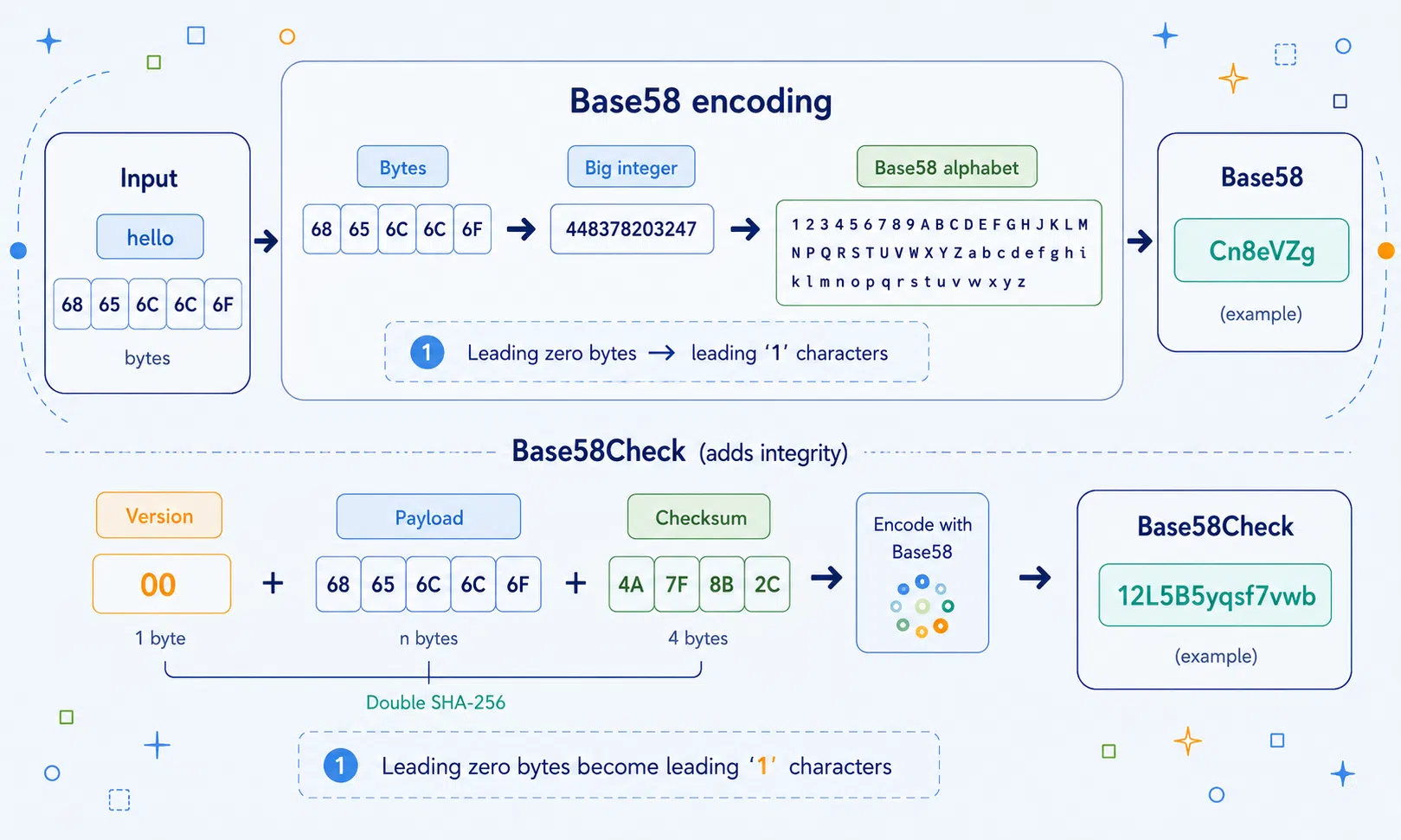
Base58 looks, at first glance, like just another way of writing data. It is not as familiar as hexadecimal. It is not as common as Base64. It is not as visibly old-fashioned as Morse code or A1Z26. But it solves a very particular problem:
How do you turn raw binary data into text that humans can copy, paste, read, type, and compare without constantly tripping over awkward characters?
That problem matters more than it first appears. Computers are comfortable with bytes. Humans are not. A machine can handle any sequence of raw binary values, but a person usually needs something that fits inside a text box, survives being pasted into a message, and does not confuse a zero with a capital O.
That is where Base58 comes in.
Base58 is a binary-to-text encoding. It takes bytes and rewrites them using a carefully chosen alphabet of 58 characters. Its alphabet deliberately avoids characters that are easy to confuse, especially 0, O, I, and l. It also avoids symbols such as +, /, and =, which often appear in Base64 and can be awkward in URLs, filenames, command lines, forms, and copied text.
Base58 became especially famous through Bitcoin, where a checksummed version called Base58Check was used for classic Bitcoin address formats and other wallet-related strings. Base58Check is Base58 with an extra safety layer: it adds a small checksum so software can detect many typing, copying, or pasting errors.
That distinction is important. Base58 is not encryption. Base58Check is not encryption either. They do not hide information from someone who understands the encoding. Instead, they solve a practical representation problem: they make binary data easier for humans and software systems to handle as text.
That makes Base58 one of those quiet encodings that sits between worlds. It belongs partly to software plumbing, partly to cryptography culture, partly to Bitcoin history, and partly to the everyday problem of making machine data readable enough for human hands.
Base58 / Base58Check at a Glance
| Feature | Base58 / Base58Check |
|---|---|
| Type | Binary-to-text encoding |
| Main idea | Convert bytes into compact text using 58 human-friendly characters |
| Alphabet | 123456789ABCDEFGHJKLMNPQRSTUVWXYZabcdefghijkmnopqrstuvwxyz |
| Avoids | 0, O, I, l, plus symbols such as +, /, and = |
| Key | None |
| Encryption? | No |
| Reversible? | Yes |
| Base58Check | Base58 plus version byte and checksum |
| Famous use | Classic Bitcoin-style address encoding |
| Security role | Not secret; useful for representation and error detection |
| Best use | Learning binary-to-text encodings, checksums, and human-friendly data formats |
What Is Base58?
Base58 is an encoding system for turning bytes into text.
It belongs to the same broad family as hexadecimal, Base32, Base64, and Ascii85. These systems do not encrypt information. They represent information. Their job is to take data that may not be safe or convenient to display directly and rewrite it using a controlled alphabet of printable characters.
Hexadecimal uses 16 characters:
0123456789ABCDEF
Base64 commonly uses 64 characters:
A-Z, a-z, 0-9, plus symbols such as + and /
Base58 uses 58 characters:
123456789ABCDEFGHJKLMNPQRSTUVWXYZabcdefghijkmnopqrstuvwxyz
The missing characters are the interesting part. Base58 removes characters that are visually ambiguous or awkward in ordinary handling. There is no zero. There is no capital O. There is no capital I. There is no lowercase l.
That makes Base58 less compact than Base64, because it uses fewer symbols, but more pleasant for humans to handle. Base58 is not trying to be the mathematically densest text encoding. It is trying to be compact enough while avoiding common transcription problems.
In plain English:
Base58 turns bytes into text that is shorter than hex and less visually awkward than Base64.
That is the central idea.
The Base58 Alphabet
The most common Base58 alphabet, often associated with Bitcoin, is:
123456789ABCDEFGHJKLMNPQRSTUVWXYZabcdefghijkmnopqrstuvwxyz
At first it looks almost like ordinary letters and numbers. But it is carefully edited.
| Included | Excluded |
|---|---|
Digits from 1 to 9 |
0, because it looks like O |
| Uppercase letters except ambiguous ones | O, because it looks like 0 |
| Lowercase letters except ambiguous ones | I, because it looks like l |
| No punctuation symbols | l, because it looks like I |
| 58 usable symbols | Symbols such as +, /, and = |
The number 58 is not magic. It is what remains after starting with a larger alphanumeric set and removing the characters most likely to cause human error.
In other words, Base58 is not just a base. It is a design judgement. It says:
A slightly longer string is worth it if the result is easier to copy correctly.
That is the spirit of Base58.
Base58 vs Base64
Base64 is extremely useful. It appears all over modern software: email attachments, APIs, data URLs, certificates, tokens, and countless web systems. It is compact, standard, and widely supported.
But Base64 has some human-unfriendly characters. A typical Base64 alphabet uses letters, numbers, and symbols such as +, /, and sometimes =. Those characters are not always convenient. They can have special meaning in URLs, file paths, shell commands, forms, and other contexts. The padding character = can also look odd or be accidentally dropped.
Base58 takes a different trade-off. It uses fewer characters than Base64, so the result is usually a little longer. But it avoids punctuation and visually confusing characters. That makes it more suitable for strings that may be typed, copied, printed, spoken aloud, or checked by eye.
| Encoding | Alphabet size | Main strength |
|---|---|---|
| Hex | 16 | Very clear, but long |
| Base32 | 32 | More readable, often uppercase-friendly |
| Base58 | 58 | Compact and human-friendly |
| Base64 | 64 | Very compact, but includes awkward symbols |
| Ascii85 / Base85 | 85 | More compact, but visually busier |
Base58 is not better than Base64 in every situation. Base64 is usually the better general-purpose software encoding. Base58 is better for a particular kind of situation: compact strings that humans may have to handle safely.
That is why its design makes sense.
How Base58 Works
Base58 works by treating the input bytes as one large number, then repeatedly dividing that number by 58. The remainders from those divisions select characters from the Base58 alphabet.
That sounds abstract, but it is the same basic idea as converting decimal numbers into another base.
In decimal, we use base 10, with ten symbols:
0 1 2 3 4 5 6 7 8 9
In hexadecimal, we use base 16, with sixteen symbols:
0 1 2 3 4 5 6 7 8 9 A B C D E F
In Base58, we use base 58, with fifty-eight symbols.
The general rhythm is:
- Start with bytes.
- Interpret those bytes as a large integer.
- Repeatedly divide by 58.
- Use each remainder to choose a Base58 character.
- Preserve leading zero bytes as leading
1characters.
The leading-zero rule matters. In Bitcoin-style Base58, the character 1 represents a leading zero byte. This is why some Base58 strings begin with one or more 1 characters.
So Base58 is not a simple character substitution. It is not like Caesar, Atbash, ROT13, or A1Z26. Base58 does not replace each letter individually. It converts the whole byte sequence into a different numerical representation.
That is why it can encode arbitrary bytes, not just alphabetic text.
A Tiny Worked Example
Take the simple text:
hello
In UTF-8, that text is stored as the following bytes:
| Character | Hex byte |
|---|---|
| h | 68 |
| e | 65 |
| l | 6C |
| l | 6C |
| o | 6F |
So:
hello
becomes the byte sequence:
68 65 6C 6C 6F
When those bytes are encoded using the Bitcoin-style Base58 alphabet, the result is:
Cn8eVZg
| Form | Value |
|---|---|
| Text | hello |
| Hex bytes | 68 65 6C 6C 6F |
| Base58 | Cn8eVZg |
This is not secrecy. Anyone with a Base58 decoder can reverse it. The point is representation. Base58 gives the bytes a compact printable form.
A slightly longer example is:
| Form | Value |
|---|---|
| Text | hello world |
| Hex bytes | 68 65 6C 6C 6F 20 77 6F 72 6C 64 |
| Base58 | StV1DL6CwTryKyV |
That output is not random. It is the same bytes written in a different base.
Decoding Base58
Decoding reverses the process. A Base58 decoder takes the text string, looks up each character in the Base58 alphabet, rebuilds the large integer, and converts that integer back into bytes.
So:
Cn8eVZg
decodes back into:
68 65 6C 6C 6F
which can then be read as UTF-8 text:
hello
The process is reversible because no information is intended to be lost.
This is one of the biggest differences between encoding and hashing.
| Method | Behaviour |
|---|---|
| Base58 | hello -> Cn8eVZg -> hello |
| Hashing | hello -> hash value, with no direct decoding back to hello |
Base58 is also different from encryption. Encryption is reversible only if you have the correct key. Base58 has no key. If you know the encoding alphabet and method, you can decode it.
That is why Base58 should never be described as secure encryption.
It is useful, but it does not keep secrets.
What Is Base58Check?
Base58Check is a structured version of Base58.
Plain Base58 simply converts bytes into a Base58 string. Base58Check adds extra information before encoding, usually:
- A version byte.
- The payload data.
- A checksum.
Then the combined bytes are encoded as Base58.
| Part | Purpose |
|---|---|
| Version byte | Identifies the type of encoded data |
| Payload | The useful data |
| Checksum | Helps detect typing or copying errors |
| Base58 encoding | Converts the full byte sequence into readable text |
The checksum is usually produced by hashing the version byte and payload, taking a small part of the result, and appending it before Base58 encoding.
The important thing is that the checksum is not a password and not a secret. It is an error-detection device.
If someone mistypes a Base58Check string, software can decode it, recompute the checksum, and compare it with the checksum stored inside the string. If the checksums do not match, the string is probably wrong.
This is especially useful for things like addresses, identifiers, and other compact strings where a single copied character can matter.
How Base58Check Works
Base58Check adds an error-checking wrapper around Base58.
A simplified Base58Check encoding process looks like this:
- Start with the payload bytes.
- Add a version byte at the front.
- Compute a checksum from the version byte and payload.
- Append the checksum.
- Encode the whole result in Base58.
The result is still a Base58 string, but it contains extra structure.
A common conceptual layout is:
version byte + payload + checksum
Then Base58 encoding turns that byte sequence into readable text.
The checksum is normally 4 bytes long. Its job is to catch mistakes. If a user types the wrong character, removes a character, or pastes a damaged string, the checksum will usually fail when decoded.
Because the checksum is 4 bytes long, a random incorrect string has only about a 1 in 2^32 chance of passing the check by accident:
1 / 2^32 = about 1 in 4.29 billion
That makes Base58Check useful for detecting accidental copying errors, but it still does not provide secrecy or authentication.
For example, suppose the payload is:
hello
and the version byte is:
00
The versioned payload is:
00 68 65 6C 6C 6F
A checksum is calculated from those bytes and appended. Then the full byte sequence is encoded as Base58Check.
Using the Bitcoin-style Base58 alphabet and a 00 version byte, the Base58Check result is:
12L5B5yqsf7vwb
The leading 1 comes from the leading zero byte. In Bitcoin-style Base58, leading zero bytes become leading 1 characters.
A decoder can reverse the Base58, recover the version byte, recover the payload, recover the checksum, and check whether the checksum matches.
If it matches, the string is probably intact.
If it does not match, the string is probably mistyped, damaged, or not actually valid Base58Check.
The Version Byte
The version byte is one small byte placed at the start of the data before the checksum is calculated. Its purpose is to identify what kind of thing is being encoded.
For example, in Bitcoin-related contexts, different version bytes have been used to distinguish different kinds of address or key material. The same Base58Check idea can encode different kinds of byte payloads, but the version byte tells software how to interpret them.
In a general educational tool, the version byte is useful because it lets you see how Base58Check is built:
| Part | Example |
|---|---|
| Version byte | 00 |
| Payload | Bytes for hello |
| Checksum | First 4 bytes of a hash result |
| Final output | Base58Check string |
Without the version byte, the payload is just bytes. With the version byte, the string can carry a small type marker.
That does not make it secret. It makes it structured.
Why the Checksum Matters
The checksum is the difference between "this is just Base58 text" and "this Base58 string can detect many copying errors."
Imagine a long string that someone has to copy from one screen to another. A single wrong character could change the decoded bytes completely. Without a checksum, a decoder may still produce bytes, but the user might not know the result is wrong.
Base58Check helps solve that.
When a Base58Check string is decoded, the software can calculate what the checksum should be and compare it with the checksum included in the string.
If they match, the data has passed the check.
If they do not match, something is wrong.
That does not prove the data is meaningful. It does not prove the data is safe. It does not prove that a Bitcoin address belongs to anyone in particular. But it does help detect accidental errors.
This is the basic value of checksums throughout computing. They are small pieces of calculated redundancy. They give software a way to say:
This string has probably survived copying intact.
That is why Base58Check is more than cosmetic. It uses encoding plus a small integrity check.
Base58 in Bitcoin
Base58 became widely known because of Bitcoin.
Classic Bitcoin addresses used Base58Check to represent address data in a compact, human-typable form. Instead of asking users to handle raw bytes, the system presented a string made from the Base58 alphabet. The string avoided confusing characters and included a checksum so that many typing errors could be detected.
This made sense for the early Bitcoin environment. People needed addresses that could be copied, pasted, printed, sent in messages, and checked by software. A raw byte sequence would have been unusable for ordinary people. Hex would have been longer. Base64 would have introduced awkward characters. Base58Check gave a more human-friendly compromise.
Modern Bitcoin also uses other address formats, especially Bech32 and Bech32m for native SegWit and Taproot-style addresses. So Base58Check is best understood as the classic Bitcoin address encoding, not the only Bitcoin address format.
That does not mean Base58 is "Bitcoin encryption." It is not.
Bitcoin uses cryptographic systems involving hashing, digital signatures, public keys, private keys, and elliptic curve mathematics. Base58Check is not the security engine. It is a representation layer.
| Thing | Role |
|---|---|
| Cryptographic keys | Control ownership and signatures |
| Hash functions | Create fixed-size fingerprints |
| Digital signatures | Prove control of a private key |
| Base58Check | Represents certain byte data as human-friendly text |
Base58Check became famous because it appeared near the surface of Bitcoin. Users saw it in addresses and wallet-related strings. But the underlying security came from cryptography, not from Base58 itself.
Base58 was the packaging.
Why Base58 Was Useful
Base58 was useful because it solved several small problems at once.
First, it made binary data printable. Raw bytes can contain values that do not display nicely as text. Base58 turns them into ordinary visible characters.
Second, it made strings shorter than hex. Hex is wonderfully clear, but every byte becomes two hex characters. Base58 can represent the same bytes more compactly.
Third, it avoided confusing characters. This is the signature Base58 advantage. Removing 0, O, I, and l reduces the risk of transcription mistakes.
Fourth, it avoided punctuation characters that can cause trouble in URLs, filenames, terminals, and other text environments.
Fifth, when used as Base58Check, it allowed many copying errors to be detected.
Those advantages make Base58 especially suitable for identifiers, addresses, compact data strings, and systems where humans may interact with machine-generated values.
Its usefulness is not dramatic in the way a famous military cipher might be dramatic. It is quieter than that.
Base58 is useful because it respects the messy boundary between computers and people. Computers want bytes. People want readable strings. Base58 gives them a compromise.
Weaknesses and Limitations
Base58 has an important limitation:
It does not provide secrecy.
This cannot be said strongly enough. Base58 is not encryption. It does not require a key. It does not prevent decoding. It does not protect passwords, private messages, personal data, files, financial information, or secrets.
If someone sees a Base58 string, and they know it is Base58, they can decode it.
That is not a flaw in Base58. It is simply not what Base58 is for.
| Limitation | Why it matters |
|---|---|
| No secrecy | Anyone can decode it |
| No key | There is no access control |
| Not always standardised across all systems | Some systems use different Base58 alphabets |
| Less compact than Base64 | It uses fewer symbols |
| Plain Base58 has no checksum | Mistakes may decode into wrong bytes |
| Base58Check detects errors but does not fix them | It can warn you, not repair the data |
| Checksum is not authentication | It does not prove who created the data |
Base58Check improves error detection, but it still does not provide encryption. A checksum can tell you that a string is probably damaged. It cannot tell you that the original data was safe to reveal.
The right mental model is:
| Method | What it gives you |
|---|---|
| Base58 | Readable representation |
| Base58Check | Readable representation plus error detection |
| Encryption | Confidentiality with a key |
| Hashing | One-way fingerprinting |
| Digital signature | Proof of authorship or control |
Base58 belongs firmly in the representation category.
How Base58 Is "Broken"
Base58 does not really get broken, because it is not trying to resist an attacker.
A Caesar cipher can be broken because it is pretending to hide a message. Base58 is different. It is an open encoding. Decoding it is not an attack. It is the intended operation.
If someone says:
Can you crack this Base58?
the better answer is usually:
You do not crack it. You decode it.
That is an important educational point.
Base58 may make data look strange to a casual viewer, but unfamiliar appearance is not security. This is the same trap that appears with Base64, hex, URL encoding, Morse code, and many other encodings.
The mistake is thinking:
I cannot read it immediately, therefore it must be encrypted.
That is false.
A Base58 string may look cryptic, but if it is only Base58, it is fully reversible. The only extra issue with Base58Check is whether the checksum validates. If it does, the string has probably been copied correctly. If it does not, the string may be damaged or may not be Base58Check at all.
So Base58 is not broken through cryptanalysis. It is decoded through ordinary parsing.
The real lesson is that not every strange-looking string is a cipher. Some are encodings.
Related Encodings and Comparisons
Base58 is easiest to understand when compared with nearby encodings.
| Encoding | Relationship to Base58 |
|---|---|
| Hex | Simpler and clearer, but longer |
| Base32 | More human-friendly than Base64, often used for recovery codes and authenticator secrets |
| Base58 | More compact than Base32 and avoids confusing characters |
| Base64 | More compact than Base58, but includes symbols such as +, /, and = |
| Ascii85 / Base85 | More compact still, but visually busier |
| URL encoding | Makes text safe inside URLs rather than compacting bytes |
| A1Z26 | Encodes letters as alphabet positions, but not arbitrary binary data |
| Morse code | Represents characters as signal patterns, not bytes |
| Base58Check | Base58 plus versioning and checksum |
| Bech32 / Bech32m | Modern Bitcoin-style address encodings with their own checksum design |
Hex is the easiest to inspect by eye. Every byte becomes exactly two characters. That makes it excellent for debugging and education, but inefficient for long data.
Base64 is extremely practical for software. It packs data efficiently and is heavily used across web systems. But it includes symbols and padding that can be inconvenient in some settings.
Base32 is less compact but more readable in some human contexts, especially where uppercase-only strings are helpful.
Ascii85 and Base85 pack data more densely than Base64, but the output can look more cluttered.
Base58 sits in the middle. It is not the shortest. It is not the simplest. But it has a strong human-handling argument.
That is why it has lasted.
Where Base58 Appears Today
Today, Base58 is most strongly associated with cryptocurrency and blockchain systems, especially because of its historical use in Bitcoin-style address encoding.
But the underlying idea is broader.
You may encounter Base58 or Base58-like strings in:
- Cryptocurrency addresses.
- Wallet import formats.
- Blockchain identifiers.
- Content-addressed systems.
- Compact IDs.
- Developer tools.
- Encoded byte strings.
- Systems that need copy-safe text.
The reason is usually the same: the system needs a compact textual representation that avoids visually confusing characters.
Base58 is also useful educationally. It teaches the difference between encoding and encryption, shows how binary data can be represented in different bases, and introduces the idea of checksummed strings through Base58Check.
For learners, that makes it a useful bridge. It connects simple encodings like hex and Base64 to more cryptographic-looking systems like Bitcoin addresses, without pretending that the encoding itself is what provides the security.
Python Implementation
Here is a simple educational implementation of Base58 and Base58Check.
It is written for clarity rather than speed. The goal is to show the mechanism: bytes become a large number, that number is repeatedly divided by 58, and Base58Check adds a checksum before encoding.
Python exampleShow code
import hashlib

ALPHABET = "123456789ABCDEFGHJKLMNPQRSTUVWXYZabcdefghijkmnopqrstuvwxyz"


def base58_encode(data: bytes) -> str:
    """Encode bytes as a Base58 string."""
    if not data:
        return ""

    # Count leading zero bytes. In Base58, each leading zero becomes "1".
    leading_zeros = 0
    for byte in data:
        if byte == 0:
            leading_zeros += 1
        else:
            break

    # Treat the whole byte sequence as one large integer.
    number = int.from_bytes(data, "big")

    # Repeatedly divide by 58 and use the remainders as alphabet indexes.
    encoded = ""
    while number > 0:
        number, remainder = divmod(number, 58)
        encoded = ALPHABET[remainder] + encoded

    return "1" * leading_zeros + encoded


def base58_decode(text: str) -> bytes:
    """Decode a Base58 string back into bytes."""
    if not text:
        return b""

    number = 0

    for char in text:
        if char not in ALPHABET:
            raise ValueError(f"Invalid Base58 character: {char!r}")

        number = number * 58 + ALPHABET.index(char)

    # Convert the large integer back into bytes.
    byte_length = (number.bit_length() + 7) // 8
    decoded = number.to_bytes(byte_length, "big") if number else b""

    # Restore leading zero bytes from leading "1" characters.
    leading_ones = len(text) - len(text.lstrip("1"))

    return b"\x00" * leading_ones + decoded


def checksum(data: bytes) -> bytes:
    """Return the first 4 bytes of double SHA-256."""
    first_hash = hashlib.sha256(data).digest()
    second_hash = hashlib.sha256(first_hash).digest()
    return second_hash[:4]


def base58check_encode(payload: bytes, version: bytes = b"\x00") -> str:
    """Encode payload bytes using Base58Check."""
    if len(version) != 1:
        raise ValueError("Version must be exactly one byte.")

    versioned_payload = version + payload
    full_data = versioned_payload + checksum(versioned_payload)

    return base58_encode(full_data)


def base58check_decode(text: str) -> tuple[bytes, bytes]:
    """Decode Base58Check and verify the checksum.

    Returns:
        (version_byte, payload)
    """
    decoded = base58_decode(text)

    if len(decoded) < 5:
        raise ValueError("Base58Check data is too short.")

    version = decoded[:1]
    payload = decoded[1:-4]
    given_checksum = decoded[-4:]
    expected_checksum = checksum(decoded[:-4])

    if given_checksum != expected_checksum:
        raise ValueError("Invalid Base58Check checksum.")

    return version, payload


message = "hello"
payload = message.encode("utf-8")

plain_base58 = base58_encode(payload)
recovered = base58_decode(plain_base58).decode("utf-8")

checked = base58check_encode(payload, version=b"\x00")
version, checked_payload = base58check_decode(checked)

print("Plaintext       :", message)
print("Base58          :", plain_base58)
print("Decoded         :", recovered)
print("Base58Check     :", checked)
print("Version byte    :", version.hex().upper())
print("Check payload   :", checked_payload.decode("utf-8"))
Expected output:
Plaintext       : hello
Base58          : Cn8eVZg
Decoded         : hello
Base58Check     : 12L5B5yqsf7vwb
Version byte    : 00
Check payload   : hello
Reading the Code Like the Encoding
The code follows the same logic as the encoding itself.
First, the input text is converted into bytes:
payload = message.encode("utf-8")
For hello, those bytes are:
68 65 6C 6C 6F
Then base58_encode() treats the whole byte sequence as one large integer:
number = int.from_bytes(data, "big")
This is the key conceptual step. Base58 is not replacing one character at a time. It is converting a whole byte sequence into a number and then writing that number in base 58.
The repeated division happens here:
number, remainder = divmod(number, 58)
encoded = ALPHABET[remainder] + encoded
Each remainder chooses a character from the Base58 alphabet.
The leading-zero handling happens separately:
return "1" * leading_zeros + encoded
That line exists because converting bytes into an integer can otherwise lose leading zero bytes. Base58 preserves them with leading 1 characters.
Base58Check adds this step:
full_data = versioned_payload + checksum(versioned_payload)
That line builds the full structure:
version byte + payload + checksum
Then the full byte sequence is encoded with Base58.
The checksum function is:
first_hash = hashlib.sha256(data).digest()
second_hash = hashlib.sha256(first_hash).digest()
return second_hash[:4]
That means the checksum is the first 4 bytes of a double SHA-256 hash.
Again, this is not encryption. It is error detection. If a Base58Check string is decoded and the checksum does not match, the string is probably not valid.
Common Questions About Base58
Is Base58 encryption?
No. Base58 is encoding, not encryption. It does not use a secret key and it does not protect information. Anyone who knows the Base58 alphabet and method can decode it.
Is Base58Check encryption?
No. Base58Check is also not encryption. It is Base58 with extra structure, usually a version byte and checksum. The checksum helps detect errors, but it does not keep the data secret.
Why does Base58 remove 0, O, I, and l?
Because those characters are easy to confuse in many fonts and handwriting styles. Removing them makes Base58 strings easier to copy and check by eye.
Why does Base58 often appear in Bitcoin?
Bitcoin popularised Base58Check for representing certain byte data, including classic address formats and wallet-related strings. Base58Check made those strings compact, human-typable, and able to detect many copying mistakes.
Do all Bitcoin addresses use Base58Check?
No. Classic Bitcoin address formats used Base58Check, but modern Bitcoin also uses Bech32 and Bech32m address formats, especially for native SegWit and Taproot-style addresses.
What is the difference between Base58 and Base58Check?
Plain Base58 only encodes bytes into Base58 text. Base58Check adds a version byte and checksum before encoding, so the decoded string can be checked for likely copying errors.
Can Base58 store ordinary text?
Yes. Ordinary text can be converted into bytes, usually UTF-8 bytes, and then encoded as Base58. For example, hello becomes Cn8eVZg.
Can Base58 encode binary files?
In principle, yes. Base58 can encode arbitrary bytes. In practice, it is usually used for relatively short byte sequences, because very large Base58 strings are not especially convenient.
Is Base58 better than Base64?
Not universally. Base64 is more compact and very widely used. Base58 is less compact but more human-friendly because it avoids visually confusing characters and awkward symbols.
Why do some Base58 strings start with 1?
In Bitcoin-style Base58, leading zero bytes are represented as leading 1 characters. So a string that begins with 1 may be preserving one or more leading zero bytes from the original data.
Does a valid Base58Check checksum prove the data is safe?
No. It only suggests that the string has probably been copied intact. It does not prove that the data is trustworthy, meaningful, secure, or safe to use.
Should I paste real private keys into a Base58 tool?
No. You should not paste real private keys, wallet seeds, passwords, or sensitive financial data into ordinary online tools. Base58 is often seen around cryptocurrency, but the encoding itself does not protect secrets.
The Real Lesson of Base58
Base58 is not a lock, a cipher, or a security system.
Its value is quieter than that. It sits at the boundary between machine data and human handling: addresses, identifiers, byte strings, wallet data, and compact values that need to survive copying, pasting, reading, and typing.
A secure system can fail at the edges if humans cannot handle its data safely. A single mistyped character can matter. A confusing alphabet can create errors. A raw byte sequence may be useless unless it can be carried through human-facing software.
Base58 turns bytes into text. Base58Check adds a warning light for mistakes.
Together, they show that cryptographic systems do not only need strong mathematics. They also need representations that humans can handle safely.
That is why Base58 matters.
Not because it hides data.
Because it makes data survivable in human hands.