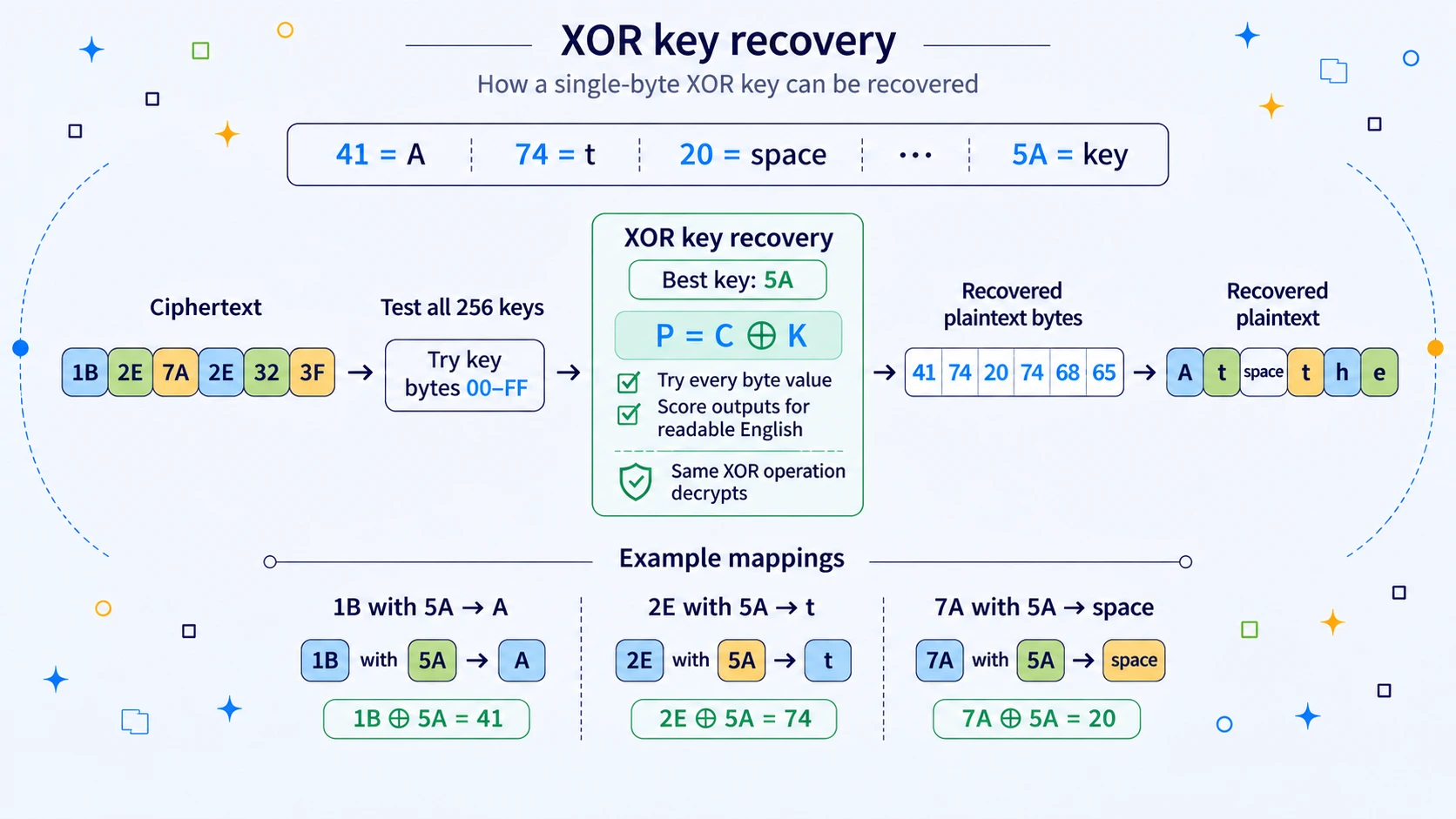
An encrypted message arrives as a sequence of apparently meaningless hexadecimal values:
1B 2E 7A 2E 32 3F 7A 38 3F 3D 33 34 ...
There are no recognisable words, no obvious sentence structure and no key supplied with the message. It might seem that recovering the original text would require an enormous amount of guesswork. Yet if the message was encrypted using a single repeated XOR byte, there are only 256 possible keys. A computer can test every one of them almost instantly, producing a collection of candidate plaintexts from which the original message can often be identified.
The situation becomes considerably more interesting when the encryption key contains several bytes. A five-byte key, for example, has more than a trillion possible combinations. Searching them all individually would be an inefficient way to attack the problem. Fortunately, if those five bytes are simply repeated throughout the message, their repetition introduces statistical patterns that an analyst can exploit. Instead of treating the ciphertext as one enormous puzzle, it becomes possible to divide it into smaller problems, each involving only a single unknown key byte.
There is also a third possibility. Suppose the analyst already knows that part of the original message contains a particular phrase, perhaps a conventional greeting, a predictable file header or some previously recovered text. Because of the mathematical properties of XOR, a known plaintext byte and its corresponding ciphertext byte reveal the key byte used to combine them. Under the right circumstances, a short fragment of known text can therefore expose a complete repeating encryption key without the need for statistical guessing.
These three approaches form the basis of the CipherRegister XOR Brute Force Cracker. The tool can exhaustively test single-byte XOR keys, analyse ciphertext encrypted with repeating multi-byte keys, and recover key information from known plaintext. It also provides ranked candidate solutions and explanations of the operations involved, allowing visitors to examine not merely whether a message can be decrypted, but why a particular attack succeeds.
The most important principle to understand from the outset is that XOR itself is not necessarily insecure. The same mathematical operation appears in elementary encryption exercises, software obfuscation, modern stream ciphers and the theoretically unbreakable one-time pad. What determines whether an XOR-encrypted message is vulnerable is not simply the use of XOR, but the way its key is generated, repeated and protected.
Which XOR Tool Should I Use?
If you already have the key and want to encrypt or decrypt a message, use the XOR Cipher encoder and decoder. Its companion XOR Cipher article explains the byte operation, key formats and reversible transformation. This article and the XOR Brute Force Cracker address the other task: investigating ciphertext without a known key, using exhaustive search, statistical clues or a correctly aligned plaintext fragment.
XOR Brute Force at a Glance
| Feature | XOR Brute Force Cracker |
|---|---|
| Purpose | Recover unknown keys and plaintext from simple XOR encryption |
| Attack methods | Single-byte brute force, repeating-key analysis and known-plaintext recovery |
| Single-byte search | All 256 possible byte values |
| Repeating-key search | Candidate recovery across permitted lengths, with Hamming-distance diagnostics |
| Known-plaintext attack | Derives key bytes from matching plaintext and ciphertext |
| Supported input | Hexadecimal, Base64 and UTF-8 text |
| Key representation | Hexadecimal and printable ASCII where applicable |
| Analysis | Ranked candidates, Hamming distances and byte-by-byte XOR calculations |
| Main weakness exploited | Short or repeated key material |
| Typical applications | Cryptography education, puzzles and authorised software analysis |
| Principal limitation | Short messages, binary data and unpredictable keystreams |
The distinction between the three attack methods is important. Single-byte XOR cracking is genuine exhaustive brute force because every possible key is tested. Repeating-key XOR cracking uses statistical analysis to reduce the search space, while known-plaintext recovery exploits direct mathematical relationships between the original message, the encrypted message and the key.
Although all three methods aim to recover information hidden by XOR encryption, they demonstrate different principles of cryptanalysis. Understanding those differences provides a much more useful foundation than simply treating the process as a collection of buttons that somehow turn ciphertext into readable text.
Understanding XOR Encryption
XOR is short for exclusive OR, a logical operation that compares two binary digits and returns 1 when they differ and 0 when they are the same. Unlike ordinary OR, which returns 1 when either or both inputs are 1, XOR requires exactly one of its inputs to be 1. Its behaviour can be represented by four possibilities: 0 XOR 0 gives 0, 0 XOR 1 gives 1, 1 XOR 0 gives 1, and 1 XOR 1 gives 0.
Although this definition sounds elementary, XOR is a fundamental operation in computing. It appears in digital logic, error detection, data manipulation and cryptographic algorithms because it combines binary values efficiently and, crucially, can be reversed by applying the same value again. In encryption, the operation is usually performed on bytes rather than individual bits. Each byte contains eight bits and can therefore represent one of 256 values, ranging from 0 to 255 in decimal or from 00 to FF in hexadecimal.
Consider the capital letter H. Its ASCII value is 72 in decimal, equivalent to 48 in hexadecimal or 01001000 in binary. Suppose we encrypt this letter using the hexadecimal key byte 5A, whose binary representation is 01011010. XOR compares the two bytes one bit at a time, producing 00010010, or 12 in hexadecimal.
Plaintext H    01001000    (48 hex)
Key            01011010    (5A hex)
               --------
Ciphertext     00010010    (12 hex)
The encrypted result is no longer an ordinary printable English character. In fact, hexadecimal 12 represents a control character. This helps explain why XOR ciphertext is often displayed in hexadecimal or Base64 rather than as ordinary text. The operation can generate any byte value, including values that do not correspond to readable characters or that might be altered when copied through text-processing software.
The defining feature of XOR encryption is its reversibility. If a plaintext byte $P$ is combined with a key byte $K$, producing ciphertext $C$, the encryption formula is:
$$ C=P\oplus K. $$
Here, the symbol $\oplus$ represents XOR. Decryption uses the same operation:
$$ P=C\oplus K. $$
This works because XORing a value with itself produces zero, while XORing a value with zero leaves it unchanged. Consequently,
$$ (P\oplus K)\oplus K=P. $$
The two occurrences of the key cancel one another, restoring the original plaintext. Unlike some encryption systems, XOR does not require a separate mathematical procedure for decryption. The same operation works in both directions, provided the correct key is available.
That last qualification explains the entire problem of XOR cryptanalysis. Recovering the original message is mathematically trivial once the key is known. The difficulty lies in discovering the key from the encrypted information alone.
How Single-Byte XOR Encryption Works
The simplest form of XOR encryption uses the same byte as a key for every character in a message. If the key is 5A, every plaintext byte is combined with 5A, regardless of its position. This creates a particularly weak encryption system because only 256 different keys are possible, and every byte in the ciphertext has been transformed in exactly the same way.
To see the process in practice, consider the plaintext HELLO. Using 5A as the key, the letter H, represented by 48, becomes 12. The letter E, represented by 45, becomes 1F. Both occurrences of L, represented by 4C, become 16, while O, represented by 4F, becomes 15. The complete encrypted message is therefore:
12 1F 16 16 15
| Plaintext | Plaintext hex | Key | Ciphertext hex |
|---|---|---|---|
| H | 48 |
5A |
12 |
| E | 45 |
5A |
1F |
| L | 4C |
5A |
16 |
| L | 4C |
5A |
16 |
| O | 4F |
5A |
15 |
Notice that the two L characters produce the same ciphertext byte. This is not a coincidence. Whenever the same plaintext byte is combined with the same key byte, the result must be identical. A fixed-byte XOR cipher therefore preserves certain patterns in the original message, although those patterns are expressed through different byte values.
An analyst who receives this ciphertext without the key could attempt to decrypt it using 00, then 01, then 02, continuing through every possible value up to FF. One of those attempts must produce HELLO, because the actual key is necessarily included among the 256 possibilities. The problem is not whether the correct result can be generated, but whether it can be recognised as the correct result.
With a message as short as HELLO, this distinction is significant. Several incorrect keys might produce printable characters or combinations that resemble words. The ciphertext simply does not contain enough information to establish a unique linguistic interpretation with high confidence. A longer message is much easier to analyse because ordinary language contains many statistical patterns that are unlikely to survive an incorrect decryption.
The CipherRegister tool's single-byte example uses a longer English passage encrypted with 5A. Its opening ciphertext is 1B 2E 7A 2E 32 3F 7A 38 3F 3D 33 34, which decrypts to the beginning of the phrase At the beginning. The longer passage gives the scoring algorithm much more information with which to distinguish the correct key from misleading alternatives.
Why Single-Byte XOR Is So Easy to Brute Force
A byte contains eight binary digits, and each digit can take one of two values. The number of possible byte combinations is therefore:
$$ 2^8=256. $$
This is an exceptionally small key space by modern cryptographic standards. Even an ordinary computer can perform the few thousand XOR operations required to test all keys against a modestly sized message almost instantaneously. There is no need for sophisticated hardware, distributed computing or elaborate optimisation.
An exhaustive single-byte attack simply applies every possible key value to the ciphertext, stores the resulting plaintext candidates and ranks them according to some measure of plausibility. Because every key is included, the actual plaintext will always appear among the results when the ciphertext was genuinely produced using a constant one-byte XOR key and the original bytes have been preserved correctly.
However, the presence of the correct answer among the candidates does not guarantee that an automated system will place it first. A computer needs some way to distinguish meaningful plaintext from random-looking output, and that normally requires assumptions about the original message. If the plaintext is expected to be English, the program can compare each result against the characteristic patterns of English text. If the plaintext is an image, a compressed file or a sequence of arbitrary bytes, those assumptions may be entirely inappropriate.
This is an important difference between brute-force searching and cryptanalysis more generally. The exhaustive part of the procedure can be mathematically certain, while the interpretation of its results remains uncertain. The computer can prove that it has tested all 256 possible keys; it cannot necessarily prove which resulting message the sender intended.
How a Computer Recognises the Correct Plaintext
English is not a random sequence of characters. Some letters occur far more frequently than others, particular combinations appear repeatedly, and spaces and punctuation follow recognisable patterns. The letter E is common, as are T, A, O, I and N. Sequences such as th, he, in, and and the occur much more often than arbitrary combinations of letters. These regularities give cryptanalysis software a way to distinguish likely English from the meaningless output of an incorrect key.
A simple scoring algorithm might give positive scores to printable characters, spaces and common letters while penalising control bytes or unusual character combinations. A more sophisticated system can also examine pairs and groups of characters, rewarding sequences that resemble natural language. The precise scoring method can vary, but the central idea remains the same: a candidate plaintext is more promising when its statistical characteristics resemble those of the expected language.
One possible scoring model is:
$$ S(P)=\sum_{i=1}^{n}s(P_i)+\sum_{i=2}^{n}b(P_{i-1},P_i). $$
In this expression, $s(P_i)$ measures the plausibility of an individual character, while $b(P_{i-1},P_i)$ evaluates the relationship between adjacent characters. An implementation might extend this approach to three-character sequences and longer fragments. The score provides a basis for comparing candidates, but it is not automatically a probability that a particular result is correct.
This is why the CipherRegister cracker displays several ranked candidates instead of presenting only one apparently definitive solution. When the original plaintext is ordinary English and sufficiently long, the correct candidate will often stand out clearly. When the original message is short or unusual, several candidates may receive similar scores, and the user must interpret the results cautiously.
The proportion of printable characters can be useful, but it must not be confused with certainty. A message consisting entirely of readable letters can still be nonsense, while a correctly decrypted binary file may contain many non-printable bytes. Cryptanalysis depends on matching the analysis technique to the expected characteristics of the original data.
Repeating-Key XOR: A More Interesting Problem
Single-byte XOR is weak because the same transformation is applied to every byte. A natural attempt to improve it is to use several key bytes instead of one. Rather than combining the entire message with 5A, the sender might choose a short word such as DOG, convert it into its byte values and repeat those values throughout the message.
The ASCII characters D, O and G have hexadecimal values 44, 4F and 47. The first plaintext byte is therefore XORed with 44, the second with 4F, and the third with 47. The fourth byte uses 44 again, and the process continues until the entire message has been encrypted.
Suppose the plaintext is MEET AT NOON. Encrypting it with the repeated keyword DOG produces:
09 0A 02 10 6F 06 10 6F 09 0B 00 09
The first three ciphertext bytes come from combining M, E and E with D, O and G respectively. At position three, the key repeats from the beginning, so the letter T is encrypted using D. Spaces are treated in exactly the same way as letters, because XOR operates on byte values rather than on alphabetic characters.
The mathematical relationship is:
$$ C_i=P_i\oplus K_{i\bmod m}, $$
where $m$ is the number of bytes in the repeating key. The expression $i\bmod m$ returns the remainder after dividing the byte position by the key length. It ensures that the program returns to the beginning of the key whenever the end is reached.
At first glance, this seems to create a substantially harder problem. A three-byte key has $256^3$, or 16,777,216, possible combinations. A five-byte key has:
$$ 256^5=2^{40}=1,099,511,627,776 $$
possible values, while an eight-byte key has $2^{64}$ combinations. Exhaustively testing every possible multi-byte key quickly becomes far less attractive than the trivial 256-key search used against single-byte XOR.
However, repeating-key XOR contains a structural weakness that makes this enormous theoretical key space somewhat misleading. Every position in the ciphertext is not encrypted under an independent key byte. Instead, the same small collection of key bytes is reused over and over again. Once the length of that repeated sequence is known or estimated, the ciphertext can be separated into groups in which every byte has been encrypted using the same unknown value.
The problem then begins to resemble several single-byte XOR attacks rather than one impossibly large search.
How Repetition Reveals the Encryption Key
Return to the keyword DOG. Its three bytes are reused at positions 0, 1 and 2, then again at positions 3, 4 and 5, and so on. Consequently, ciphertext positions 0, 3, 6 and 9 were all encrypted using D. Positions 1, 4, 7 and 10 used O, while positions 2, 5, 8 and 11 used G.
If an analyst suspects that the key is three bytes long, the ciphertext can be rearranged into three groups containing bytes from these corresponding positions. The first group becomes a single-byte XOR problem with D as the unknown key, the second with O, and the third with G. The analyst can then evaluate each group separately, trying all 256 possible values and scoring the resulting bytes according to their likely plaintext characteristics.
This technique is sometimes called transposing the ciphertext into columns. Although the word transposition might suggest physically moving letters around, the purpose here is analytical rather than cryptographic. No new encryption is being performed. The ciphertext is simply reorganised so that bytes encrypted with the same key position can be examined together.
For the short message MEET AT NOON, each group contains only four bytes, which is not enough to produce reliable English-language statistics. In a message containing several hundred or several thousand bytes, however, each group provides considerably more evidence. Spaces, common letters and characteristic bit patterns begin to emerge, allowing the correct key byte to receive a stronger score than its competitors.
Once the individual key bytes have been estimated, they can be reassembled in their original order and used to decrypt the entire message. The resulting plaintext can then be scored as a whole. This last stage is particularly valuable because a key that produces individually plausible byte groups may still produce an incoherent full message. Considering the complete plaintext allows the analysis to reject some misleading combinations and refine the candidate key.
The difficulty is that the analyst usually does not know the key length in advance. A message encrypted with a five-byte key cannot reliably be divided into three-byte columns, because those columns would contain bytes encrypted under different key positions. Discovering the period of the repeating key is therefore one of the most important stages of the attack.
Finding the Key Length With Hamming Distance
A common method of estimating the length of a repeating XOR key uses a mathematical quantity called the Hamming distance. The Hamming distance between two equal-length binary sequences is simply the number of bit positions at which they differ.
For example, compare the bytes 00001111 and 11110000. Every bit in the first byte differs from its counterpart in the second, giving a Hamming distance of eight. If the two bytes differed in only three positions, their Hamming distance would be three.
XOR provides a convenient way to calculate this distance. XORing the two sequences produces a 1 wherever their bits differ, so the Hamming distance is equal to the number of 1-bits in the result. This count is often called the population count, or popcount.
For two blocks of $m$ bytes, the normalised Hamming distance can be expressed as:
$$ D(A,B)=\frac{1}{m}\sum_{i=1}^{m}\operatorname{popcount}(A_i\oplus B_i). $$
Normalisation makes it possible to compare blocks of different lengths without automatically favouring shorter blocks simply because they contain fewer bits. The result represents the average number of differing bits per byte.
The connection to repeating-key XOR is subtle but important. If two ciphertext blocks are separated by exactly one key period, corresponding positions have been encrypted using the same key bytes. XORing those ciphertext positions together causes the repeated key bytes to cancel, leaving the XOR of the corresponding plaintext bytes. Because natural-language text contains statistical structure, these relationships can produce patterns that differ from those expected when unrelated key bytes are compared.
An analyst can therefore test several possible key lengths, divide the ciphertext into blocks of each proposed size and compare their normalised Hamming distances. A relatively small distance suggests that the proposed length may align with the key's actual period.
This is not a perfect test. Natural language is variable, accidental similarities can occur, and multiples of the true period may produce attractive results. A five-byte key, for example, also repeats over ten-byte intervals, so a ten-byte candidate can appear plausible even though the underlying key is only five bytes long. Short messages introduce additional uncertainty because there may not be enough blocks to obtain representative comparisons.
The CipherRegister XOR Brute Force Cracker displays these measurements in its Key-Length Analysis chart. The chart helps users see which periods merit investigation, but it should be interpreted as statistical evidence rather than a definitive identification of the key length. The complete attack also needs to recover candidate key bytes and judge whether they produce coherent plaintext.
A Worked Example: Recovering a Repeating XOR Key
The repeating-key example included in the CipherRegister tool uses the five-character ASCII keyword ORBIT. Its key bytes are 4F, 52, 42, 49 and 54 in hexadecimal, and these five values are repeated throughout a longer English passage.
The original message begins:
At the beginning of the investigation ...
After XOR encryption with ORBIT, the opening ten ciphertext bytes are:
0E 26 62 3D 3C 2A 72 20 2C 33
The first byte is produced by XORing the capital A, hexadecimal 41, with O, hexadecimal 4F, giving 0E. The second byte combines the lowercase t, 74, with R, 52, giving 26. The third combines a space, 20, with B, 42, producing 62. The process continues through the remaining key characters before returning to O for the sixth plaintext byte.
If the attacker knows that the key contains five bytes, the ciphertext can immediately be divided into five groups according to position modulo five. The first group contains every fifth byte beginning at position zero, the second every fifth byte beginning at position one, and so on. Each group can then be analysed using the same single-byte search principles described earlier.
When the key length is unknown, a general repeating-key attack can use Hamming-distance analysis to prioritise plausible periods. This implementation instead attempts every permitted length within the selected range, recovers candidate key bytes for each length and ranks the reconstructed messages using English-language scoring with a penalty for unnecessarily long keys. Hamming distances are shown separately as supporting evidence, not used to exclude lengths from the search. Because the example contains a reasonably long passage of ordinary English, there is enough statistical information to recover ORBIT as a strong candidate.
The process is not equivalent to testing every one of the $2^{40}$ possible five-byte keys. Instead, it exploits the fact that the same five bytes recur at predictable intervals. That is what makes the search practical.
The method also explains why longer ciphertexts often make repeating-key XOR easier to crack rather than harder. A longer message contains more encrypted information, but it also gives the attacker more examples of every key byte being reused. The resulting statistical evidence can become much stronger as the amount of available ciphertext increases.
This is one of the recurring paradoxes of weak cryptographic systems: encrypting more information under the same small key can reveal more about that key.
Known-Plaintext Attacks: Recovering Keys Directly
Statistical analysis becomes unnecessary when the analyst already knows part of the original plaintext and where it occurs in the ciphertext. XOR has a particularly useful property in this situation because knowing any two of the three values—plaintext, ciphertext and key—allows the third to be calculated immediately.
The relevant identity is:
$$ K=P\oplus C. $$
Suppose the analyst has the ciphertext from our earlier DOG example:
09 0A 02 10 6F 06 10 6F 09 0B 00 09
They also know that the original message begins with MEET. The first letter M has the hexadecimal value 4D, and the first ciphertext byte is 09. XORing those values gives 44, which corresponds to D. The second plaintext letter E has value 45, and the second ciphertext byte is 0A. XORing them gives 4F, corresponding to O.
Repeating the calculation for the next two letters reveals G and D. The recovered keystream fragment is therefore DOGD. The fourth byte matches the first, suggesting that the key may repeat every three bytes. If that assumption is correct, the entire key is DOG, and the rest of the message can be decrypted.
This illustrates why knowing a fragment of plaintext can be more useful than possessing a very large amount of ciphertext. The analyst is no longer asking which key produces the most plausible language. Instead, the known plaintext establishes direct equations for the key bytes at the corresponding positions.
For a known plaintext fragment beginning at ciphertext offset $s$, the relationship for a repeating key of length $m$ is:
$$ K_{(s+j)\bmod m}=P_j\oplus C_{s+j}, $$
where $j$ is the position within the known fragment. The formula accounts for the fact that the plaintext fragment may begin somewhere in the middle of the message, rather than at the first byte.
The alignment is essential. If the analyst believes a phrase begins at byte 20 but it actually begins at byte 21, the recovered values will generally be incorrect. There is also an important distinction between byte positions and character positions. A non-ASCII character represented in UTF-8 may occupy several bytes, so counting visible characters does not always give the correct ciphertext offset.
The CipherRegister tool's known-plaintext mode allows the user to supply a suspected text fragment, its byte offset and an assumed repeating-key length. It then calculates the implied key bytes and places them into the corresponding positions of the repeating key.
When the fragment does not cover every key position, some bytes remain unknown. The tool displays those unresolved values rather than inventing them. If different positions imply contradictory values for the same repeated key byte, the tool reports that inconsistency, indicating that the fragment, alignment or key-length assumption may be wrong.
There is a further distinction worth understanding. XORing known plaintext with matching ciphertext always reveals the keystream bytes used over that fragment, but it does not necessarily reveal how those bytes were generated. The ability to apply them elsewhere depends on the key repeating in the manner assumed. A fragment recovered from a modern nonrepeating keystream does not automatically allow the remaining ciphertext to be decrypted.
Why Hexadecimal and Base64 Matter
XOR operates on bytes, not on the visual characters used to display encrypted data. This creates an important practical distinction between the ciphertext itself and the encoding used to represent it.
Suppose a ciphertext byte has the value 0E. When written in hexadecimal, it appears as two characters, 0 and E, but those characters are merely a representation of one underlying byte. If a program mistakenly treats them as two ordinary text characters and XORs their character codes, it is no longer analysing the original ciphertext.
Hexadecimal is particularly convenient for cryptanalysis because every byte is represented by exactly two hexadecimal digits. Values such as 00, 7F and FF can be displayed consistently, regardless of whether they correspond to printable characters. Spaces and other separators may be added for readability without changing the underlying byte values.
Base64 solves a related problem by representing binary data using a restricted set of printable characters. It is commonly used when binary content must be transported through systems designed primarily for text. However, Base64 does not provide encryption or secrecy. A Base64 representation of XOR ciphertext must first be decoded back into its original bytes before the XOR attack is performed.
UTF-8 text requires additional care. Ordinary English characters generally occupy one byte each, but many other characters require two, three or four bytes. Arbitrary XOR ciphertext may not form a valid UTF-8 sequence at all. Copying such data through a text field can alter the original bytes, making the ciphertext impossible to recover accurately.
For this reason, hexadecimal or Base64 is usually preferable when working with encrypted binary data. The CipherRegister tool supports both formats, along with UTF-8 text input for cases where the supplied data genuinely consists of text characters.
Correctly identifying the representation is not a minor technicality. An attack that begins with the wrong ciphertext bytes cannot recover the correct key, regardless of how sophisticated its statistical analysis might be.
Using the CipherRegister XOR Brute Force Cracker
The accompanying CipherRegister tool brings these cryptanalytic methods together in a single browser-based interface. It provides three modes—Single-byte, Repeating-key and Known plaintext—along with input-format controls, ranked candidates and a byte-by-byte explanation of selected results. The calculations are performed locally in the browser, making it possible to experiment without submitting the ciphertext to a remote analysis service.
The simplest place to begin is Single-byte mode. Select the mode and click Load Example to insert a sample encrypted using the key 5A. The input is displayed in hexadecimal, so the ciphertext can be examined as a sequence of exact byte values. Clicking Crack Ciphertext causes the program to test all 256 possible single-byte keys and evaluate the resulting candidate plaintexts.
The results appear in a ranked list showing up to 12 candidates, not every generated result. In single-byte mode all 256 keys are tested, but a correct decryption that scores poorly can fall outside the displayed shortlist. Selecting a candidate updates the displayed plaintext and corresponding key, allowing the user to inspect alternatives rather than relying entirely on the tool's initial ranking. The byte-by-byte breakdown provides another useful perspective by showing how the selected key transforms individual ciphertext bytes into their corresponding plaintext values.
Once that process is understood, switch to Repeating-key mode and load its example. This sample uses the keyword ORBIT, repeated across a longer passage of English text. The tool analyses possible key lengths, attempts to recover the corresponding key bytes and ranks the resulting plaintexts. Its key-length chart displays normalised Hamming-distance measurements, helping to illustrate why certain periods appear more plausible than others.
The maximum key-length setting can be adjusted from 2 to 32 bytes when analysing your own ciphertext. Repeating-key mode needs at least 30 bytes and considers lengths that leave at least four ciphertext bytes per key position; a passage of 200 bytes or more is a better starting point. Increasing the limit allows the program to consider longer repeating keys, but it does not guarantee a better result. A long key requires a sufficiently long message to provide repeated examples of each key position. With only a small amount of ciphertext, the statistics may be too weak to support reliable recovery.
Finally, Known plaintext mode demonstrates a fundamentally different approach. The built-in example supplies a suspected plaintext fragment beginning with At the beginning of the investigation, together with an offset of zero and an assumed key length of five bytes. Because the fragment covers every position in the repeating ORBIT key, the tool can recover the complete key through direct XOR calculations.
Experimenting with a shorter known fragment is particularly instructive. If the fragment no longer covers all positions in the key, some bytes remain unresolved. This makes it clear that known-plaintext recovery does not conjure information from nowhere: it reconstructs the values mathematically implied by the material available.
When examining any result, it is important to distinguish a promising candidate from a proven solution. A decrypted passage that contains coherent sentences, appropriate punctuation and a plausible key is considerably more convincing than one containing a few recognisable words surrounded by nonsense. Conversely, a candidate should not be dismissed merely because it contains non-printable bytes if the original plaintext was expected to be binary data.
The tool accepts up to 32 KiB of decoded ciphertext. Language scoring examines the first 4,096 bytes, so it is the beginning of the message that chiefly determines the ranking. A candidate's text percentage counts printable ASCII and ordinary whitespace in that scoring sample; it is not a probability of success. The plaintext preview shows at most 8,000 bytes, while Copy plaintext (hex) preserves the complete recovered byte sequence when the key is fully known. With a partial key, unresolved key bytes appear as ??, unresolved output positions are marked with middle dots, and full plaintext export remains unavailable.
The tool is most useful when its results are treated as evidence to be examined rather than as an infallible declaration that a message has been solved.
Why Some XOR Messages Are Much Harder to Crack
The success of XOR cryptanalysis depends heavily on the properties of the original message and the way its key was used. Single-byte XOR is easy to search exhaustively, but the correct result may still be difficult to recognise when the plaintext is very short. A ciphertext containing only a few bytes provides little evidence of language structure, and several incorrect keys may produce superficially plausible output.
Repeating-key XOR introduces a different difficulty. The statistical approach assumes that the key has a relatively short period and that the ciphertext contains enough repetitions to reveal meaningful patterns. If the original message is shorter than the key, every plaintext position might be encrypted using a different key byte. The column-based method then loses the repeated observations on which it depends.
The nature of the plaintext also matters. Ordinary English contains helpful redundancies, whereas compressed data is designed to remove many predictable patterns. Encrypted image data, executable files and other binary formats may contain structures that require specialised analysis rather than generic English-language scoring. A perfectly correct key can appear unpromising if the recovered output is assessed using inappropriate assumptions.
An incorrect understanding of the encryption system can be equally problematic. XOR is used within many cryptographic constructions, but that does not mean those constructions consist of a short key repeated over the plaintext. Modern stream ciphers generate complex keystreams intended to resist precisely the kinds of statistical attacks that defeat elementary repeating-key XOR.
This is why a simple XOR cracker cannot be treated as a universal decryptor. It is designed to investigate particular weaknesses, not to defeat encryption merely because XOR appears somewhere in the algorithm.
The One-Time Pad: When XOR Becomes Unbreakable
One of the most surprising facts about XOR encryption is that the same elementary operation used in a trivial single-byte cipher can also form the basis of a system with perfect secrecy.
The one-time pad combines a plaintext message with a truly random secret key stream of the same length. Every key bit is independently and uniformly random, the key remains secret, and the same key material is never reused. Under those conditions, the ciphertext reveals no information about the plaintext to an attacker who does not know the key.
The encryption formula is still:
$$ C=P\oplus K. $$
What changes is the nature of $K$. Instead of being a repeated byte or a short keyword, it is an unpredictable sequence covering the entire message. There is no short period to detect and no small key space to search.
The reason for perfect secrecy is mathematical. Given any particular ciphertext and any possible plaintext of the same length, there is exactly one key stream that transforms that plaintext into the ciphertext. Because all possible key streams are equally likely, the ciphertext does not favour the real plaintext over any other candidate.
This result was formalised by Claude Shannon and is fundamentally different from the practical security of ordinary encryption algorithms. Modern encryption is generally designed to make attacks computationally infeasible; a correctly implemented one-time pad provides a stronger theoretical guarantee that ciphertext alone contains no information about the original message.
However, the conditions are demanding. Generating genuinely random key material, distributing it securely, storing it safely and ensuring that it is never reused can be difficult in practice. Reusing a one-time-pad key introduces a serious vulnerability because XORing two ciphertexts encrypted under the same keystream causes that keystream to cancel.
If two messages are encrypted with the same key stream, then:
$$ \begin{aligned} C_1\oplus C_2 &=(P_1\oplus K)\oplus(P_2\oplus K)\\ &=P_1\oplus P_2. \end{aligned} $$
The result reveals the XOR of the two plaintexts. Although this does not immediately disclose either complete message, language redundancy and known fragments can make the relationship exploitable. This is the classic danger of reusing key material in a system intended to function as a one-time pad.
The distinction provides an important lesson. XOR is not weak because its mathematics is simple. It becomes weak when the key stream contains predictable or repeated information.
XOR Cryptanalysis and Classical Cipherbreaking
Although XOR operates on bytes rather than alphabetic characters, its weaknesses have interesting parallels with older cryptographic systems. A Caesar cipher uses one fixed shift throughout a message, allowing an attacker to test its small collection of possible shifts. Single-byte XOR has a larger set of 256 transformations, but the principle of exhaustive search is similar: every candidate key can be examined without difficulty.
Repeating-key XOR has an even closer conceptual relationship with the Vigenère cipher. Vigenère encryption uses a repeating keyword to select a succession of alphabetic shifts, while repeating-key XOR applies a succession of XOR byte values. The mathematics differs, but both systems expose a periodic structure that becomes useful once the key length is estimated. In both cases, separating the ciphertext into groups associated with individual key positions can turn one difficult problem into several simpler ones.
Frequency analysis is central to both approaches. Ordinary language is statistically uneven, and encryption that merely rearranges or repeatedly transforms those patterns may leave enough information for an attacker to infer the key. Repeating-key XOR does not eliminate language statistics; it distributes them across multiple groups, each of which can be studied after the period has been identified.
The comparison with modern stream ciphers is especially revealing. Many secure stream ciphers also combine plaintext bytes with keystream bytes using XOR. However, their keystreams are generated using carefully designed algorithms intended to make the output computationally indistinguishable from random data to an attacker who does not possess the secret key. The weakness in repeating-key XOR is therefore not the exclusive-OR operation, but the primitive method of generating the keystream.
This reinforces a broader principle of cryptography: the security of a system depends on the complete construction, including its key generation, state management and resistance to statistical analysis. A secure algorithm can contain simple operations, while an insecure algorithm can appear mathematically complicated.
A Small Python Implementation
XOR brute force is an excellent programming exercise because the underlying operation is so simple that attention can be focused on key search, scoring and data representation. A basic single-byte cracker requires little more than a loop over the 256 possible key values, an XOR transformation and a function that estimates whether the result resembles English.
The following Python example demonstrates that approach. It also includes a short known-plaintext calculation to illustrate the difference between guessing a key and deriving one directly from known data. The scoring function is deliberately simple, so it should be regarded as an educational demonstration rather than a substitute for the more elaborate analysis in the CipherRegister tool.
Python exampleShow code
from string import ascii_letters, digits


def xor_with_key(data: bytes, key: bytes) -> bytes:
    """XOR data with a repeating key."""
    if not key:
        raise ValueError("Key must not be empty")

    return bytes(
        value ^ key[i % len(key)]
        for i, value in enumerate(data)
    )


def english_score(data: bytes) -> float:
    """Estimate how much a byte sequence resembles English."""
    common = b" etaoinshrdluETAOINSHRDLU"
    allowed = set(
        (ascii_letters + digits + " .,!?'-\n").encode()
    )

    total = 0.0

    for byte in data:
        if byte == 32:
            total += 3.0
        elif byte in common:
            total += 2.0
        elif byte in allowed:
            total += 0.5
        else:
            total -= 5.0

    return total / max(len(data), 1)


def crack_single_byte(ciphertext: bytes):
    candidates = []

    for key_byte in range(256):
        key = bytes([key_byte])
        plaintext = xor_with_key(ciphertext, key)

        candidates.append(
            (english_score(plaintext), key_byte, plaintext)
        )

    return sorted(candidates, reverse=True)


message = (
    b"At the beginning of the investigation, "
    b"the team checked every message."
)

ciphertext = xor_with_key(message, b"\x5a")

best = crack_single_byte(ciphertext)[0]

print("Key:", f"{best[1]:02X}")
print("Plaintext:", best[2].decode("utf-8"))


# Recover a key-stream fragment from known plaintext.
secret = b"DOG"
example = xor_with_key(b"MEET AT NOON", secret)

recovered = xor_with_key(example[:4], b"MEET")

print(
    "Recovered key-stream fragment:",
    recovered.decode("ascii")
)
The expected output is:
Key: 5A
Plaintext: At the beginning of the investigation, the team checked every message.
Recovered key-stream fragment: DOGD
The first result is obtained by testing every single-byte key and selecting the candidate with the strongest English-language score. The second uses no search at all. Because the first four plaintext bytes and their corresponding ciphertext bytes are known, the program can recover the matching key-stream fragment through XOR alone.
The recovered fragment is DOGD, which is consistent with the three-byte repeating key DOG. Recognising that period is a separate inference from calculating the individual key bytes. This distinction becomes increasingly important when the assumed key length is unknown or the available plaintext fragment is too short to cover every position.
A full repeating-key cracker requires additional steps for estimating the key length, transposing ciphertext positions, scoring candidate key bytes and evaluating reconstructed messages. Those operations make the implementation considerably longer, but they are built upon the same elementary XOR operation demonstrated here.
Where XOR Brute Force Is Useful
Simple XOR encryption is frequently encountered in programming exercises, cryptography challenges and puzzle design. Its mathematical simplicity makes it an accessible way to introduce concepts such as key spaces, exhaustive search, byte representation and statistical language analysis. A student can understand the basic transformation almost immediately, then explore increasingly sophisticated methods for recovering unknown keys.
XOR is also sometimes used as a lightweight form of software obfuscation. A developer might transform a string or other small piece of data so that it does not appear directly in a file or program. Such techniques should not be confused with secure encryption, because an analyst who recognises the transformation may be able to recover the original data using precisely the methods described in this article.
In authorised software analysis and reverse-engineering exercises, examining suspected XOR-encoded data can therefore be useful. File signatures, familiar text fragments and repeated key patterns may provide clues about how an unfamiliar program stores or transforms information. The same principles can also help diagnose mistakes in custom encryption schemes, where developers have relied on a short repeated XOR key without appreciating its limitations.
The CipherRegister cracker is intended for these kinds of educational and analytical tasks. It provides a practical environment for exploring why some messages are easily recovered, how repeating-key attacks work and what information known plaintext can reveal.
The central question in any investigation is not merely whether XOR was used. It is whether the key material was short, reused, predictable or otherwise exposed in a way that creates an exploitable relationship between plaintext and ciphertext.
What XOR Brute Force Teaches Us
XOR cryptanalysis provides a particularly clear demonstration of the relationship between encryption strength and key design. The operation itself is almost trivial: compare two bits, output 1 when they differ, and apply the same transformation again to reverse the process. Yet the difficulty of recovering a message can range from negligible to theoretically impossible, depending entirely on the properties of the keystream.
A single-byte key creates only 256 possibilities, making exhaustive search straightforward. A repeating multi-byte key initially appears much stronger because its theoretical search space grows exponentially with the number of bytes. But repetition creates a pattern that can be exploited statistically, allowing the analyst to estimate the key length and reconstruct individual key bytes from separate groups of ciphertext.
Known-plaintext attacks reveal another side of the problem. When some original text is already known, its corresponding key bytes can be calculated directly. No language scoring is required, and the amount of ciphertext available may be less important than the precision of the known fragment and its alignment.
The one-time pad illustrates the opposite extreme. By replacing a short repeated key with a fresh, genuinely random keystream as long as the message, XOR can provide perfect secrecy. There is no recurring structure to exploit and no statistical information in the ciphertext that identifies the intended plaintext.
These examples show why cryptography cannot be judged simply by the apparent complexity of an algorithm. Sophisticated-looking transformations can contain fundamental weaknesses, while remarkably simple operations can form part of extremely secure systems.
The real lesson of XOR brute force is that encryption fails when the secret key leaves behind patterns that the attacker can recognise, reconstruct or eliminate. Understanding those patterns is what turns an apparently unreadable sequence of bytes into a solvable problem.
Try the XOR Brute Force Cracker
The best way to understand XOR cryptanalysis is to experiment with ciphertext whose original plaintext and encryption key are known. Open the XOR Brute Force Cracker and begin with the single-byte example. Watch how the program tests every possible byte key and compares the resulting messages, then select different candidates to see how changing the key affects the recovered text.
Next, explore the repeating-key example and examine how the tool identifies promising key lengths before reconstructing the keyword ORBIT. The key-length analysis and byte-by-byte breakdown make it possible to follow the reasoning behind the recovered result, rather than treating the output as an unexplained answer.
Finally, try the known-plaintext mode and observe how a correctly aligned fragment reveals the corresponding key bytes directly. Shorten the fragment, change the offset or adjust the assumed key length to see how the available evidence affects what can be recovered.
XOR is one of the simplest operations in computing, but its cryptanalysis introduces several of the most important ideas in the study of encryption: exhaustive search, statistical inference, key repetition, known plaintext and perfect secrecy.
The operation is simple. The security lies in the key.