There is a phrase that cryptographers learn to distrust: unbreakable encryption.
The history of secret writing is crowded with systems that once wore that label. Ingenious inventors, military offices, diplomats and salesmen have all announced that their latest cipher could never be solved. Again and again, the claim lasted only until a patient codebreaker found the pattern that the inventor had overlooked. Caesar shifts surrendered to brute force. Monoalphabetic substitutions leaked the statistical shape of language. Repeating-key systems divided themselves into smaller, easier problems. Mechanical machines with astronomical-looking settings fell when procedures, operators and repeated habits gave analysts a foothold.
The one-time pad is different.
When it is constructed and used correctly, it is not merely difficult to break with present-day computers. It is not protected by the hope that an attacker lacks enough money, time or processing power. It remains secure even against an adversary with unlimited computation, because the ciphertext itself contains no information that allows one possible plaintext to be preferred over another. That is not advertising language. It is a precise mathematical property known as perfect secrecy.
But this extraordinary strength comes with an equally extraordinary catch. The key must be genuinely random. It must be at least as long as the message. It must remain completely secret. Above all, every part of it must be used only once. Break any of those conditions and the one-time pad may cease to be a one-time pad at all. Reuse the same key material, and two apparently opaque messages begin to reveal information about each other. Generate the pad from a memorable phrase, and human predictability replaces mathematical randomness. Lose control of the pad before it is destroyed, and the attacker does not need to break the cipher; they can simply read the key.
The one-time pad is therefore one of cryptography’s most beautiful paradoxes. Its arithmetic is simple enough to perform with pencil and paper, yet its security can be absolute. Its weakness is not hidden in the formula, but in the physical and organisational world surrounding it. It does not fail because the mathematics is too weak. It fails because perfect key management is a far harder human problem than adding letters together.
That tension is what makes the one-time pad worth learning. It is both the strongest cipher in theory and one of the most inconvenient ciphers in practice. It shows, with unusual clarity, that cryptographic security does not live in an algorithm alone. It lives in the entire system: randomness, distribution, storage, synchronisation, authentication, operator discipline and destruction.
One-Time Pad at a Glance
| Feature | One-Time Pad |
|---|---|
| Type | Symmetric additive cipher using a one-use keystream |
| Main idea | Combine every plaintext symbol with an independent random key symbol |
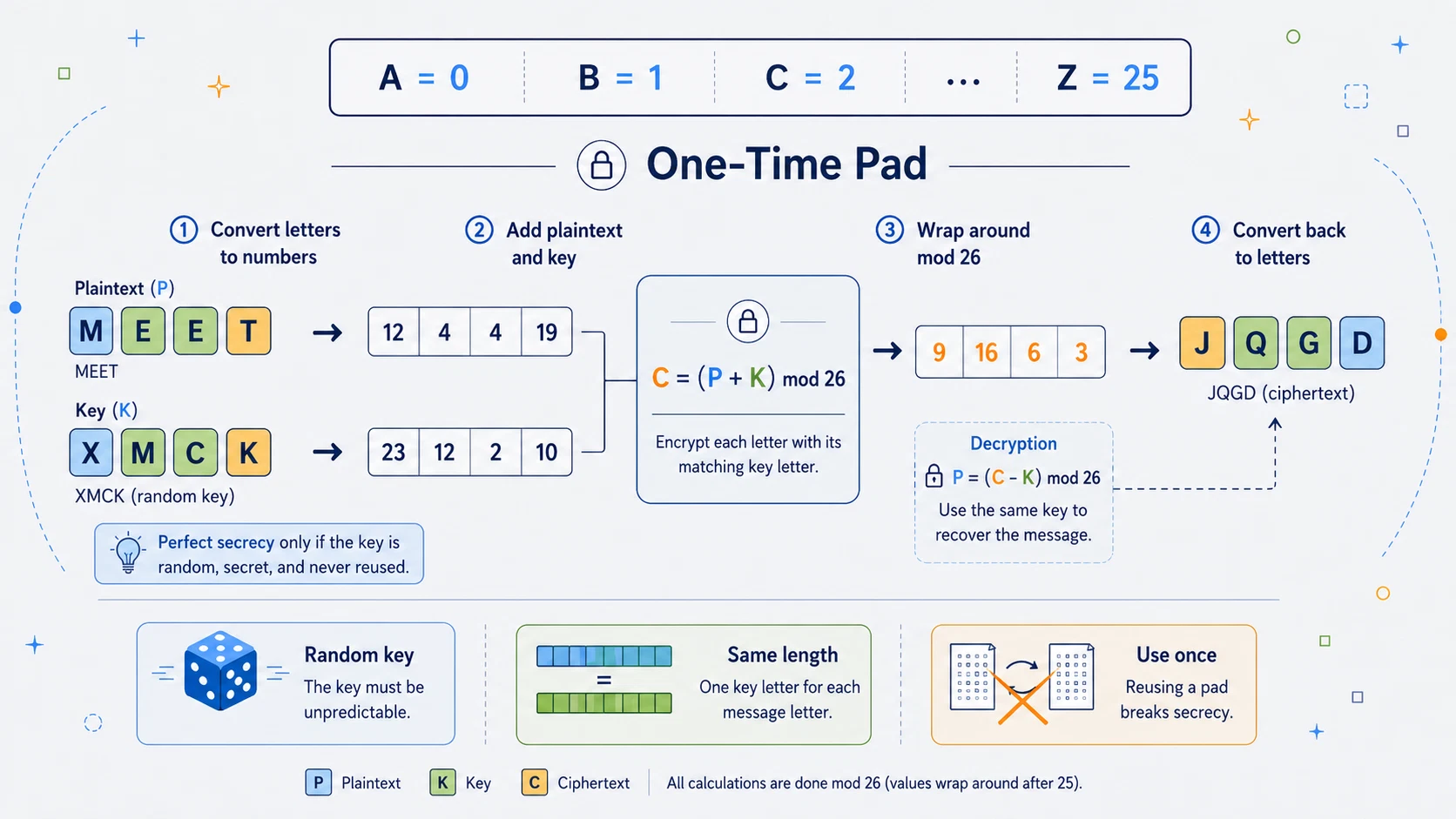
| Alphabetic encryption | $C=(P+K)\bmod 26$ |
| Alphabetic decryption | $P=(C-K)\bmod 26$ |
| Binary form | $C=P\oplus K$, with decryption $P=C\oplus K$ |
| Key | Truly random, secret, at least as long as the message, and never reused |
| Example key | XMCKLQWERTYU |
| Example | MEETMEATNOON → JQGDXUWXEHMH |
| Decryption | Subtract the same alphabetic pad, or XOR the same binary pad again |
| Security | Perfect secrecy when every condition is satisfied |
| Main limitation | Secure key generation, distribution, storage and destruction |
| Catastrophic mistake | Reusing any portion of the pad |
| Best use | Learning perfect secrecy, randomness, keystreams and operational security |
The one-time pad is sometimes described as a classical cipher, sometimes as a stream cipher, and sometimes as a special form of the Vernam cipher. All three descriptions point towards part of the truth. In the alphabetic version, every plaintext letter is shifted by a different key letter, so it resembles an extreme polyalphabetic cipher. In the digital version, every plaintext bit is combined with a key bit using XOR, so it resembles a stream cipher. Historically, it grew from Gilbert Vernam’s teleprinter encryption system and the later insistence that the key material be random and non-repeating.
The terminology matters because Vernam cipher and one-time pad are not automatically interchangeable. A system may combine text with a keystream in the Vernam manner while still repeating or algorithmically generating that stream. It becomes a true one-time pad only when the key is random, long enough, secret and never reused.
What Is a One-Time Pad?
A one-time pad is a symmetric encryption system in which sender and receiver share a secret sequence of random symbols. Each plaintext symbol is combined with the corresponding key symbol to produce one ciphertext symbol. The receiver reverses the operation using an identical copy of the same pad.
The word symmetric means that the communicating parties possess the same secret key material. There is no public key that can be safely distributed to strangers. Before any message is sent, the sender and receiver must already share the pad through some secure channel. That requirement is the source of both the system’s strength and its inconvenience.
For an alphabetic teaching version, the message and key are represented with numbers from 0 to 25:
$$ A=0,\quad B=1,\quad C=2,\quad \ldots,\quad Z=25. $$
The plaintext number and key number are added, and the result wraps around the alphabet modulo 26:
$$ C=(P+K)\bmod 26. $$
To decrypt, the receiver subtracts the same key value:
$$ P=(C-K)\bmod 26. $$
In a digital one-time pad, the same central idea is expressed with bits and XOR:
$$ C=P\oplus K. $$
XOR has the useful property that applying the same key twice restores the original value:
$$ (C\oplus K)=(P\oplus K)\oplus K=P. $$
The alphabetic and binary versions look different on the page, but conceptually they are doing the same thing. A message is combined with an independent random mask. The mask is not a short password that repeats. It is not a seed fed into a generator. It is not an ordinary English phrase. It is a complete secret object with as much fresh uncertainty as the message it protects.
That last point is the heart of the system. Most practical encryption algorithms expand a short secret key into a long pseudorandom-looking keystream. Their security is computational: breaking them should require an infeasible amount of work. The one-time pad does not expand a small secret into a large one. It begins with a large secret. The key is as long as the protected information because the key itself supplies the uncertainty that conceals the message.
The Alphabet Becomes Modular Arithmetic
The alphabetic version begins by numbering the letters.
| Letter | A | B | C | D | E | F | G | H | I | J | K | L | M |
|---|---|---|---|---|---|---|---|---|---|---|---|---|---|
| Number | 0 | 1 | 2 | 3 | 4 | 5 | 6 | 7 | 8 | 9 | 10 | 11 | 12 |
| Letter | N | O | P | Q | R | S | T | U | V | W | X | Y | Z |
|---|---|---|---|---|---|---|---|---|---|---|---|---|---|
| Number | 13 | 14 | 15 | 16 | 17 | 18 | 19 | 20 | 21 | 22 | 23 | 24 | 25 |
Suppose the first plaintext letter is M and the first key letter is X.
$$ M=12,\qquad X=23. $$
Add them:
$$ 12+23=35. $$
There is no letter numbered 35, so the value wraps around modulo 26:
$$ 35\bmod 26=9. $$
The letter numbered 9 is J. Therefore:
$$ M+X\rightarrow J. $$
The next plaintext letter might be E, paired with the key letter M:
$$ E=4,\qquad M=12. $$
Then:
$$ (4+12)\bmod 26=16, $$
and 16 corresponds to Q:
$$ E+M\rightarrow Q. $$
Nothing in this arithmetic is difficult. The security does not come from hiding the formula. An attacker may know exactly how every character was combined. The protection comes from not knowing the random key values. This is an important cryptographic principle known as Kerckhoffs’s principle: a system should remain secure even when the method is public and only the key is secret.
The operation can be imagined as two alphabet wheels. The plaintext letter chooses one position. The key letter tells you how far to move. Modulo arithmetic brings the count back to A after passing Z. Unlike Caesar, however, there is no single shift applied to the entire message. Every position receives its own independent shift.
If the key is truly random, the same plaintext letter can become any ciphertext letter with equal probability. An E might become Q in one position, U in another and A in a third. Its usual frequency no longer survives in a form that can be measured. The statistical fingerprint that defeats ordinary substitution ciphers has been covered by an equally long random pattern.
The Four Rules That Make It a One-Time Pad
The formula is only the visible part of the system. The name one-time pad describes a set of conditions, and every one of them matters.
The key must be genuinely random
A person cannot safely improvise a pad by typing whatever letters come to mind. Human beings produce patterns, favour some letters, avoid others and unconsciously repeat familiar structures. A quotation, song lyric or keyboard pattern is not a pad. Nor is a sequence produced by an ordinary, predictable random-number function.
For a software demonstration, the key should come from a cryptographically secure random-number generator. The CipherRegister tool uses the browser’s Web Crypto interface to generate key letters without relying on Math.random(). That is appropriate for demonstrating the mechanism. Real-world use would still require secure handling of the generated key after it leaves the browser.
The key must be at least as long as the message
Every encrypted symbol needs fresh key material. A twelve-letter message requires twelve independently random key letters in the alphabetic version. A million-bit file requires at least a million random key bits in the binary version.
A shorter key cannot simply be repeated. Once repetition is introduced, the system becomes a repeating-key cipher and acquires the structural weaknesses that one-time pads were designed to avoid.
The key must remain completely secret
The sender and receiver need matching copies of the pad, but nobody else can be allowed to obtain it. This creates the key-distribution problem. If the parties already possess a secure method for transferring a message-length secret, why not use that secure route to transfer the message itself?
The answer is that key material can sometimes be distributed in advance, perhaps during a face-to-face meeting or through a trusted courier, and later used when only an insecure radio or telegraph channel is available. But the logistical burden is substantial. Large volumes of communication require large volumes of pre-shared secret material.
Every key symbol must be used once and only once
This is the rule that gives the cipher its name.
After a section of pad has encrypted one message, that section is finished. It must never protect another message, not even if the first message was short, unimportant or cancelled. Sender and receiver must stay synchronised about which page, line or position has been consumed. Used material should be securely destroyed.
A fresh unused section of a larger pad can protect a later message, but no position may overlap. In practice, that demands careful indexing and procedure. A repeated page number, a duplicated printing run or a moment of operator confusion can create the exact relationship an attacker needs.
These rules are not optional refinements. Remove genuine randomness, sufficient length, secrecy or one-time use, and the mathematical proof no longer applies.
A Worked Example: MEET ME AT NOON
Now encrypt the message:
MEET ME AT NOON
using the random-looking key:
XMCKL QW ER TYU
The spaces in the key are only for readability. The tool advances the key when it encounters a letter and leaves spaces and punctuation outside the arithmetic. Removing the formatting gives:
Plaintext: MEETMEATNOON
Key:       XMCKLQWERTYU
The full calculation is:
| Position | Plain | $P$ | Key | $K$ | Calculation | Result | Cipher |
|---|---|---|---|---|---|---|---|
| 1 | M | 12 | X | 23 | $(12+23)\bmod 26$ | 9 | J |
| 2 | E | 4 | M | 12 | $(4+12)\bmod 26$ | 16 | Q |
| 3 | E | 4 | C | 2 | $(4+2)\bmod 26$ | 6 | G |
| 4 | T | 19 | K | 10 | $(19+10)\bmod 26$ | 3 | D |
| 5 | M | 12 | L | 11 | $(12+11)\bmod 26$ | 23 | X |
| 6 | E | 4 | Q | 16 | $(4+16)\bmod 26$ | 20 | U |
| 7 | A | 0 | W | 22 | $(0+22)\bmod 26$ | 22 | W |
| 8 | T | 19 | E | 4 | $(19+4)\bmod 26$ | 23 | X |
| 9 | N | 13 | R | 17 | $(13+17)\bmod 26$ | 4 | E |
| 10 | O | 14 | T | 19 | $(14+19)\bmod 26$ | 7 | H |
| 11 | O | 14 | Y | 24 | $(14+24)\bmod 26$ | 12 | M |
| 12 | N | 13 | U | 20 | $(13+20)\bmod 26$ | 7 | H |
So:
MEET ME AT NOON
        +
XMCK LQ WE RTYU
        =
JQGD XU WX EHMH
Or without spaces:
MEETMEATNOON → JQGDXUWXEHMH
The repeated letters in the plaintext do not create a repeated substitution. The two Es near the beginning become Q and G because they are paired with different key letters. The two Os become H and M. A frequency analyst cannot simply search for the ciphertext symbol that stands for E, because there is no fixed ciphertext symbol for E.
This is where the one-time pad departs decisively from Caesar, Affine and general monoalphabetic substitution. Those systems rearrange the alphabet but preserve its statistical habits. The one-time pad overlays those habits with a random sequence of equal length.
Decryption: Subtracting the Pad
To recover the message, the receiver aligns the same key with the ciphertext and subtracts each key value:
$$ P=(C-K)\bmod 26. $$
Begin with the first ciphertext letter, J, and the first key letter, X:
$$ J=9,\qquad X=23. $$
Then:
$$ 9-23=-14. $$
Modulo 26 converts the negative result into the equivalent alphabet position:
$$ -14\bmod 26=12. $$
The letter numbered 12 is M.
For the second character:
$$ Q=16,\qquad M=12, $$
so:
$$ (16-12)\bmod 26=4, $$
and 4 corresponds to E.
Continuing across the message gives:
| Cipher | J | Q | G | D | X | U | W | X | E | H | M | H |
|---|---|---|---|---|---|---|---|---|---|---|---|---|
| Key | X | M | C | K | L | Q | W | E | R | T | Y | U |
| Plain | M | E | E | T | M | E | A | T | N | O | O | N |
The spaces can then be restored according to the agreed formatting:
JQGD XU WX EHMH → MEET ME AT NOON
In the binary form, XOR makes the reversal appear even neater. Because a bit XOR itself equals zero, and any bit XOR zero remains unchanged:
$$ (P\oplus K)\oplus K=P\oplus(K\oplus K)=P\oplus 0=P. $$
The same key operation both masks and unmasks the data. This self-inverse property was especially natural for teleprinter machinery, where electrical signal states could be combined automatically.
Why Perfect Secrecy Is Stronger Than “Very Difficult”
Modern security discussions often describe a cipher by the amount of computation needed to attack it. A 128-bit key, for example, creates so many possibilities that exhaustive search is considered infeasible. The claim is practical: the cipher should remain safe because the required work is beyond realistic resources.
Perfect secrecy is a different kind of statement.
Imagine that an attacker intercepts the four-letter ciphertext:
JQGD
One possible plaintext is:
MEET
because the key:
XMCK
turns MEET into JQGD.
But JQGD could just as consistently represent:
CASH
with the key:
HQOW
It could represent:
HELP
with the key:
CMVO
Or it could represent any other four-letter sequence, each accompanied by exactly one key that produces the observed ciphertext.
If every four-letter key is genuinely random and equally likely, the ciphertext does not tell the attacker which candidate is correct. Unlimited processing power does not solve this problem. A computer can enumerate every possible plaintext, but enumeration produces all of them. There is no mathematical clue inside the ciphertext that singles out the real message.
Claude Shannon formalised this idea using probabilities. A cipher has perfect secrecy when observing the ciphertext does not change the probability assigned to the plaintext:
$$ \Pr(M=m\mid C=c)=\Pr(M=m). $$
In information-theoretic language, the ciphertext reveals zero information about the message:
$$ I(M;C)=0. $$
This does not mean that every real-world one-time-pad system is automatically safe. It means that the ideal construction has an exact security property. The proof assumes that the key is independent of the message, selected with the correct random distribution, at least as large as the message space required, secret and not reused.
The one-time pad does not make the correct plaintext impossible to imagine. It makes it impossible to distinguish from all the alternatives using ciphertext evidence alone.
From Telegraph Wires to the Vernam System
The one-time pad did not emerge from a single cinematic moment of invention. Its history is a layered story involving commercial telegraphy, electrical engineering, military communications and later mathematical proof.
An early version of the central idea appeared in Frank Miller’s 1882 telegraphic codebook, which described adding changing numerical “shift” values to coded telegram groups. Miller’s contribution was largely forgotten for more than a century, and the invention was traditionally associated with later work at AT&T. Historical research by Steven Bellovin brought Miller’s priority back into view.
The better-known technical ancestor came from Gilbert S. Vernam, an engineer working in the world of automated telegraphy. Vernam’s system electrically combined the five-unit signal representing a teleprinter character with a second sequence supplied by punched key tape. His patent, issued in 1919, described a “secret signaling system” designed to alter transmitted impulses so that interception would not reveal intelligible text.
This machine-oriented design is why the term Vernam cipher is so often associated with XOR. Each teleprinter character could be represented as a pattern of binary-like signal states, and the message pattern could be combined with the key-tape pattern. Applying the same key sequence at the receiving end restored the original signals.
The step from a Vernam-style combiner to a true one-time system required the keystream to be random and non-repeating. Joseph O. Mauborgne, a U.S. Army Signal Corps officer, is traditionally associated with recognising the importance of a non-repeating random tape. Later archival analysis suggests that the division of insight was more complicated than the familiar one-sentence story: Vernam was deeply concerned with randomness, while Mauborgne emphasised the non-repetition of key material. What matters technically is the combination of both requirements.
A repeating tape could create a long period and frustrate casual inspection, but repetition eventually gives the attacker structure. A completely random tape used once removes that structure. The machine that had begun as a telegraph cipher became the practical form of a deeper cryptographic idea.
The final conceptual leap came from Claude Shannon. In 1949, his paper Communication Theory of Secrecy Systems placed cryptography inside information theory and gave a rigorous framework for perfect secrecy. Shannon did not merely say that a properly used one-time system appeared resistant to known attacks. He explained the probability conditions under which ciphertext provides no information about plaintext.
That changed the status of the one-time pad. It was no longer only an ingenious apparatus or a rule-of-thumb secure system. It became a mathematical boundary marker: an example of what absolute confidentiality means, and a demonstration of the amount of secret key material needed to obtain it.
Why Anyone Would Accept Such an Awkward Cipher
At first sight, the one-time pad seems almost self-defeating. If two parties must already share a secret as long as every future message, then the key-distribution problem appears as difficult as the communication problem itself.
Yet there are situations in which that trade-off makes sense.
A field agent may meet a handler once, receive a compact booklet of random groups and then operate for months in a place where every radio transmission is assumed to be intercepted. A diplomatic office may receive pad material through a secure courier but send routine traffic over ordinary communications lines. A military unit may prepare key tapes in a protected facility and later use them across exposed radio links. In each case, the secure physical channel is available occasionally, while the insecure electronic channel is available continuously.
The one-time pad also has a practical advantage that few high-grade ciphers share: it can be performed without a general-purpose computer. Letter tables, number groups, paper pads and disciplined procedures are enough. That matters in covert settings where electronic equipment may be unavailable, suspicious or vulnerable to seizure.
Historically, pads could appear as pages of random letters or numbers, with matching copies issued to the communicating parties. Messages were labelled with indicators telling the receiver which page or line to use. After processing, the used material was marked or destroyed. One-time tape systems automated the same broad principle for high-volume communications.
The system’s usefulness was therefore situational rather than universal. It offered exceptional confidentiality where advance distribution of bulky secret material was feasible and where users could follow exact procedures. It was never a convenient replacement for every cipher. It was a specialised answer to a particular imbalance: secure contact is rare, but later communication must cross an exposed channel.
The Price of Perfection
Perfect secrecy protects the content of a message, but it does not solve every security problem.
Key distribution is expensive
A pair of users who expect to exchange one gigabyte of one-time-pad-protected data need at least one gigabyte of shared random key material. If ten independent pairs need private channels, each pair needs its own material. The volume grows with communication rather than remaining fixed.
Modern ciphers are popular partly because a small key can protect enormous quantities of data when used with suitable nonces, modes and authentication. The one-time pad refuses that economy. It spends one secret key bit for every protected message bit.
Synchronisation must be exact
Sender and receiver must agree about the next unused key position. If one side accidentally skips a line, repeats a page or counts punctuation differently, decryption fails. Worse, an attempted correction can tempt operators into reusing material.
This is why real systems require message indicators, accounting procedures and destruction rules. The arithmetic may be simple, but the workflow is unforgiving.
Randomness must be real
A pad generated by dice can in principle be secure if the process is unbiased and carefully executed. A pad generated by a trustworthy cryptographic random source can also be secure. A pad generated from prose, dates, passwords or a predictable software routine is not.
Random-looking is not the same as random. A deterministic generator may produce output that passes visual inspection while remaining completely determined by a short internal state. If an attacker reconstructs that state, the apparent pad collapses into a short key.
Endpoints remain vulnerable
The one-time pad protects a message while it travels through an exposed channel. It cannot protect plaintext that is visible on a compromised device, pad pages photographed by an intruder, keys copied from memory, or operators coerced into revealing them.
An attacker does not have to defeat perfect secrecy if they can steal the secret before encryption or read the message after decryption.
Traffic patterns remain visible
Ciphertext can conceal content without concealing the fact that communication occurred. An observer may learn who contacted whom, when, how often and how much data was sent. Message length can itself be informative unless padding and traffic-shaping procedures are used.
One-time tape circuits were sometimes operated continuously, including during periods with no meaningful traffic, precisely because cryptographic content protection does not automatically defeat traffic analysis.
Confidentiality is not authentication
A traditional one-time pad hides what the message says, but it does not by itself prove who sent it or whether it was altered.
In the binary form, an attacker who flips selected ciphertext bits causes the corresponding plaintext bits to flip after decryption. The attacker may not know the entire message, but if part of its format is predictable, deliberate modifications may be possible. Alphabetic modular addition has a similar malleability: changing a ciphertext value by a chosen amount changes the recovered plaintext value by the same amount.
Modern secure communication normally requires authenticated encryption, which protects both confidentiality and integrity. A one-time pad must be paired with a separate, correctly designed authentication method if tampering is a concern. Reusing pad material as an authentication key would create yet another failure.
The lesson is subtle but important: “unbreakable encryption” does not mean “unbreakable communication system.”
The Two-Time Pad: When Reuse Cancels the Secret
A correctly used one-time pad cannot be cryptanalysed from ciphertext alone. A reused one can.
Suppose two plaintexts are encrypted with the same key:
$$ C_1=P_1+K\pmod{26} $$
and:
$$ C_2=P_2+K\pmod{26}. $$
Subtract the ciphertexts:
$$ C_1-C_2=(P_1+K)-(P_2+K)\pmod{26}. $$
The key cancels:
$$ C_1-C_2=P_1-P_2\pmod{26}. $$
In the binary XOR form, the same disaster is even more compact:
$$ C_1\oplus C_2=(P_1\oplus K)\oplus(P_2\oplus K)=P_1\oplus P_2. $$
The attacker has not instantly recovered both messages, but the random protection has vanished from the relationship between them. The result now contains the combined structure of two natural-language plaintexts. Language is redundant and predictable: words have familiar shapes, messages use standard greetings, reports follow templates, and certain phrases are likely in certain contexts. Those habits give cryptanalysts room to test guesses.
Imagine that the pad:
XMCKLQWERTYU
is used first on:
MEETMEATNOON
to produce:
JQGDXUWXEHMH
and then, disastrously, reused on:
SENDHELPFAST
to produce:
PQPNSUHTWTQN
If an attacker learns or confidently guesses that the first plaintext was MEETMEATNOON, they can recover the pad directly:
$$ K=C_1-P_1\pmod{26}. $$
That recovered pad immediately decrypts the second ciphertext:
PQPNSUHTWTQN
−
XMCKLQWERTYU
=
SENDHELPFAST
Even without a fully known first message, analysts can use crib dragging. A crib is a plausible fragment such as REPORT, WEATHER, Moscow, a date, a salutation or a standard operational phrase. The analyst slides the guess across the combined ciphertext relationship and checks whether the implied fragment in the other message looks like language. A promising fragment leads to more guesses, which reveal more key material, which opens more messages.
The one-time pad’s perfect secrecy is therefore brittle in a very specific way. Proper use gives the attacker nothing. Reuse gives the attacker a mathematical cancellation that no amount of key length can repair.
VENONA: A Historic Failure of One-Time Use
The most famous real-world warning comes from the VENONA project, the long-running American effort to exploit Soviet intelligence communications from the 1940s.
The Soviet systems involved more than a bare one-time pad. Words and phrases were first represented through a codebook, and the resulting numerical groups were then enciphered with additives taken from one-time-pad pages. Used correctly, that additional random layer should have been unbreakable.
But some pad pages were duplicated and reused. According to the National Security Agency’s historical account, production pressures at the Soviet cryptographic-material centre apparently caused repeated key material to appear in different messages. That error gave analysts at Arlington Hall an opening. By identifying messages “in depth”—messages sharing the same additive—they could attack relationships from which the pad should have been absent.
The work was still extraordinarily difficult. Reuse did not transform every message into immediate plaintext. Analysts had to identify duplicated material, exploit linguistic and procedural regularities, recover codebook structure and assemble fragments across a huge body of traffic. Many messages remained incomplete. The breakthrough was not a magic button; it was the result of years of cryptanalytic labour.
VENONA is important because it demonstrates the exact boundary between the ideal theorem and the real system. The mathematics of the one-time pad did not fail. The key material was not used according to the theorem’s assumptions.
That distinction is more than historical pedantry. It is how cryptographic failures should be understood. A secure primitive can be embedded inside an insecure process. A flawless formula can be defeated by duplicated pages, weak randomness, poor indexing, exposed endpoints or careless operators.
How a One-Time Pad Is Actually Attacked
A cryptanalyst facing a properly implemented one-time pad has no ciphertext-only attack that reveals the plaintext. The practical attack therefore moves outward, away from the algebra and towards the assumptions.
A sensible attacker asks:
-
Was the pad really random? If it came from a predictable generator, biased mechanical process or human-created sequence, its entropy may be much lower than its length suggests.
-
Was any key material reused? Reuse allows ciphertexts to be combined so that the key cancels. This is the classic two-time-pad attack.
-
Can part of a plaintext be guessed? Standard headers, dates, report formats, greetings and repeated operational language can act as cribs. Known plaintext reveals the corresponding pad segment.
-
Can the key be stolen? Physical pads, key tapes, print files, browser history, memory dumps, backups and photographs may be more accessible than the encrypted channel.
-
Can the endpoints be compromised? Malware, hidden cameras, keystroke capture or insider access can reveal plaintext before encryption or after decryption.
-
Can the message be modified? Without authentication, controlled ciphertext changes may create controlled plaintext changes.
-
Does metadata reveal the operation? Timing, volume, sender identity and transmission patterns can remain useful even when content is perfectly hidden.
This is a recurring pattern in serious security work. When the mathematical centre is strong, the attack migrates to implementation, procedure and people. The one-time pad makes that movement unusually visible because there is so little to attack inside the ideal cipher itself.
Vernam Cipher, One-Time Pad and XOR: The Important Distinction
The terms are often blended together in tutorials, but a careful explanation separates the operation from the security conditions.
The Vernam cipher broadly refers to combining message symbols with key-stream symbols, historically through teleprinter signal operations and in modern descriptions through XOR. If the keystream repeats, comes from a short key or is generated predictably, the result may still be called Vernam-style encryption, but it does not possess perfect secrecy.
A one-time pad is the strict case in which the keystream is genuinely random, independent, at least as long as the message, secret and never reused.
| System | Keystream | Repeats? | Security basis |
|---|---|---|---|
| Repeating-key XOR | Short key repeated | Yes | Weak; patterns and reuse are exploitable |
| Vigenère | Repeating alphabetic keyword | Yes | Weak; periodic structure enables classical attacks |
| Vernam-style stream combination | External or generated stream | Depends | Depends on how the stream is produced and managed |
| Modern stream cipher | Pseudorandom stream from short key and nonce | Not under correct nonce use | Computational security |
| One-time pad | Truly random stream as long as message | Never | Information-theoretic perfect secrecy |
This distinction prevents one of the most common errors in introductory cryptography: assuming that XOR itself creates perfect security. XOR is only the combining operation. Security depends on the properties of the key stream.
XOR with a reused password is weak.
XOR with a predictable generator is weak.
XOR with a unique keystream from a well-designed modern cipher may be computationally secure.
XOR with an independent uniform random key used once produces a one-time pad.
The same operator can participate in very different systems.
One-Time Pad Compared with Nearby Ciphers
| Cipher | Relationship to the One-Time Pad |
|---|---|
| Caesar | Uses one fixed shift for every letter; the pad uses a fresh shift at every position |
| Vigenère | Uses a repeating keyword; the pad uses a non-repeating random key as long as the message |
| Beaufort | Uses a repeating keyword with subtraction; still exposes periodic structure |
| Autokey | Extends a short key with plaintext or ciphertext; not independently random |
| Repeating-key XOR | Reuses a short binary key and is vulnerable to the same cancellation problem |
| Modern stream cipher | Generates a pseudorandom keystream from a short key and nonce; practical but computational rather than perfect security |
| AES in a secure mode | Uses a manageable secret key to protect large amounts of data; practical modern security with correct mode and authentication |
| One-time pad | Consumes fresh random key material equal to the protected message and can provide perfect secrecy |
Vigenère is the closest classical comparison. Both systems combine message letters with changing key letters. The decisive difference is repetition. A keyword such as LEMON eventually returns to its beginning:
LEMONLEMONLEMON...
That periodicity groups ciphertext positions that were encrypted under the same key letter. Kasiski examination, the index of coincidence and frequency analysis can exploit those groups.
A true pad has no period to discover. Its key stream does not cycle because it is not generated from a short keyword. Every position is independent.
Modern stream ciphers solve the practical problem in a different way. They use a small secret key and a nonce to generate a long pseudorandom keystream. The stream is not truly random in the information-theoretic sense—it is determined by the key—but a secure design makes it computationally infeasible to distinguish from random or reconstruct without the key. This trades absolute secrecy for manageable key distribution.
In ordinary digital life, that is usually the better bargain.
Where the One-Time Pad Appears Today
The one-time pad is no longer the natural choice for web browsing, online banking, messaging apps or stored files. Modern authenticated-encryption systems are far easier to deploy, scale and update. They can protect enormous amounts of traffic with compact keys and well-defined nonce rules.
The pad survives in education because it provides the cleanest possible demonstration of several major ideas:
- the difference between computational and information-theoretic security;
- the role of random keys;
- the relationship between keystream ciphers and modular arithmetic;
- the danger of reuse;
- the key-distribution problem;
- the separation of confidentiality from authentication.
It also remains culturally associated with espionage, clandestine radio and numbers stations. Lists of apparently random digits fit the practical shape of manual pad systems, though any claim about a specific transmission requires evidence. One-time pads are attractive in spy fiction because their central ritual is so tangible: matching booklets, page indicators, pencil arithmetic and the destruction of used sheets.
Puzzle designers sometimes borrow the format, but a real one-time pad is not a satisfying standalone puzzle. If the key is genuinely random and absent, there is nothing to solve. A puzzle must therefore provide the pad, conceal it somewhere, weaken its randomness, reuse it or include a known-plaintext clue. The moment a puzzle becomes solvable, it has usually stepped away from the ideal conditions.
The one-time pad also appears whenever people discuss the theoretical limits of encryption. It remains the standard example of perfect secrecy and the clearest reminder that unlimited computational power is not the same thing as unlimited information. An adversary cannot calculate information that the ciphertext never contained.
A Simple Python One-Time Pad
The following educational implementation matches the alphabetic behaviour of the CipherRegister tool. It:
- numbers letters from
A = 0toZ = 25; - generates a cryptographically secure random key with Python’s
secretsmodule; - advances the key only when a letter is processed;
- preserves spaces and punctuation;
- uses modular addition for encryption;
- uses modular subtraction for decryption.
Python exampleShow code
from __future__ import annotations

import secrets
import string

ALPHABET = string.ascii_uppercase
ALPHABET_SIZE = len(ALPHABET)


def letter_count(text: str) -> int:
    """Return the number of A-Z letters in text."""
    return sum(char.isascii() and char.isalpha() for char in text)


def generate_pad(length: int) -> str:
    """Generate a cryptographically secure random alphabetic pad."""
    if length < 0:
        raise ValueError("Pad length cannot be negative.")

    return "".join(
        ALPHABET[secrets.randbelow(ALPHABET_SIZE)]
        for _ in range(length)
    )


def clean_pad(pad: str) -> str:
    """Keep only ASCII letters and convert them to uppercase."""
    return "".join(
        char.upper()
        for char in pad
        if char.isascii() and char.isalpha()
    )


def transform(text: str, pad: str, *, decrypt: bool = False) -> str:
    """
    Encrypt or decrypt alphabetic text with a one-time pad.

    Non-letter characters are preserved and do not consume key letters.
    """
    usable_pad = clean_pad(pad)
    required = letter_count(text)

    if len(usable_pad) < required:
        raise ValueError(
            f"Pad is too short: need {required} letters, "
            f"but received {len(usable_pad)}."
        )

    output: list[str] = []
    key_index = 0

    for char in text:
        if not (char.isascii() and char.isalpha()):
            output.append(char)
            continue

        text_value = ord(char.upper()) - ord("A")
        key_value = ord(usable_pad[key_index]) - ord("A")

        if decrypt:
            result_value = (text_value - key_value) % ALPHABET_SIZE
        else:
            result_value = (text_value + key_value) % ALPHABET_SIZE

        result_char = ALPHABET[result_value]
        output.append(result_char if char.isupper() else result_char.lower())
        key_index += 1

    return "".join(output)


def encrypt(text: str, pad: str) -> str:
    return transform(text, pad, decrypt=False)


def decrypt(text: str, pad: str) -> str:
    return transform(text, pad, decrypt=True)


if __name__ == "__main__":
    plaintext = "MEET ME AT NOON"
    pad = "XMCKLQWERTYU"

    ciphertext = encrypt(plaintext, pad)
    recovered = decrypt(ciphertext, pad)

    print("Plaintext :", plaintext)
    print("Pad       :", pad)
    print("Encrypted :", ciphertext)
    print("Decrypted :", recovered)

    fresh_pad = generate_pad(letter_count(plaintext))
    print("Fresh pad :", fresh_pad)
Expected fixed-example output:
Plaintext : MEET ME AT NOON
Pad       : XMCKLQWERTYU
Encrypted : JQGD XU WX EHMH
Decrypted : MEET ME AT NOON
The final Fresh pad line changes every time because it uses secure random generation.
This code demonstrates the arithmetic correctly, but correct arithmetic is not the same as a complete secure communications system. It does not distribute the pad, authenticate the ciphertext, erase key material from memory, prevent backups, protect the endpoint or guarantee that an operator will never reuse the pad. Those are the difficult parts.
Reading the Code Like the Cipher
The function letter_count() determines how much key material the message consumes. Spaces and punctuation are preserved for readability but do not advance the key. That convention matches the web tool, although two communicating parties must always agree on the same convention. A mismatch over whether digits or punctuation consume key positions will desynchronise the message.
The generate_pad() function uses:
secrets.randbelow(ALPHABET_SIZE)
rather than Python’s general-purpose random module. The secrets module is designed for security-sensitive randomness. Each call chooses an integer from 0 to 25, which becomes one random key letter.
The central encryption line is:
result_value = (text_value + key_value) % ALPHABET_SIZE
That corresponds directly to:
$$ C=(P+K)\bmod 26. $$
Decryption changes the plus sign to a minus sign:
result_value = (text_value - key_value) % ALPHABET_SIZE
which corresponds to:
$$ P=(C-K)\bmod 26. $$
Python’s modulo operator conveniently turns a negative value into the correct wrapped alphabet position. For example:
(9 - 23) % 26
returns 12, which maps to M.
The validation step refuses to process a message when the key is too short. Quietly repeating the key would be a serious design mistake because it would transform the demonstration into a repeating-key cipher while continuing to display the name “one-time pad.”
Readable code is especially valuable here because the cipher’s lesson is not hidden complexity. The algorithm should be visible. The reader should be able to connect every program operation to a mathematical rule and every security claim to a key-management condition.
Common Questions About the One-Time Pad
Is the one-time pad really unbreakable?
A correctly constructed and correctly used one-time pad provides perfect secrecy. That means ciphertext alone gives an attacker no information about which possible plaintext was sent.
The conditions are strict: the key must be truly random, independent of the message, at least as long as the message, completely secret and never reused. A system that violates those conditions may look like a one-time pad without possessing its security.
What is the difference between a Vernam cipher and a one-time pad?
Vernam encryption describes the combination of message symbols with a keystream, classically through teleprinter signals and commonly through XOR in digital explanations.
A one-time pad is the special Vernam-style case where the keystream is genuinely random, as long as the message, secret and used once. Repeating or predictably generated keystreams do not create perfect secrecy.
Why must the key be as long as the message?
Perfect secrecy requires enough independent secret uncertainty to mask the message. If a short key is repeated, the repetition introduces relationships between positions. Those relationships can be detected and attacked.
Shannon’s framework shows that a perfectly secret system cannot generally protect more message uncertainty than is supplied by its shared secret key.
Can I use a password or quotation as the pad?
No. Passwords and quotations are predictable, structured and far less random than their character length suggests. Repeating them makes the situation worse.
A pad should be generated from a trustworthy source of cryptographic randomness.
Can I reuse the key if the first message was harmless?
No. The sensitivity of the first message does not matter. Reuse links the ciphertexts mathematically. A known or guessed harmless plaintext can reveal pad material that decrypts the important message.
Every consumed key position must remain consumed forever.
Can an unused part of a longer pad be used later?
Yes, in principle. A large random pad may be divided into non-overlapping segments, each consumed once. The danger is administrative: sender and receiver must never overlap, repeat or lose track of those segments.
The CipherRegister tool generates or accepts the number of letters required for the current message to keep the demonstration clear.
Does the one-time pad protect against message tampering?
Not by itself. It provides confidentiality but no inherent authentication. An attacker may be able to alter ciphertext in ways that alter the recovered plaintext.
A real system needs a separate secure authentication mechanism with independent key material.
Would a quantum computer break a one-time pad?
No. Perfect secrecy is not based on the assumed difficulty of a computational problem. Unlimited classical or quantum computation does not reveal information that is absent from the ciphertext.
Quantum technology does not remove the practical problems of pad distribution, storage, authentication and endpoint security.
Why preserve spaces and punctuation in the tool?
Preserving formatting makes the educational result easier to read, and the tool advances the key only for letters. Historically, systems might remove spaces, encode punctuation or use fixed groups to conceal word boundaries.
Preserving spaces leaks word lengths and message shape. In an ideal one-time-pad system this does not reveal the protected letters, but it does reveal metadata about the plaintext format.
Is browser-generated key material safe?
The tool uses the browser’s cryptographic random-number generator, which is substantially more appropriate than ordinary pseudo-random functions for creating a demonstration pad.
Real security still depends on the browser and device being trustworthy, the key being delivered securely to the receiver, copies not leaking into logs or backups, authentication being handled separately and the key never being reused. The tool teaches the cipher; it does not turn an ordinary webpage into a complete espionage communications system.
Why is the one-time pad not used everywhere?
Because perfect secrecy consumes key material at the same scale as the data being protected. Generating, delivering, storing, synchronising and destroying that material is expensive and error-prone.
Modern authenticated ciphers offer extremely strong practical security with small keys and are far easier to deploy.
The Real Lesson of the One-Time Pad
The one-time pad occupies a strange position in the history of cryptography.
It is mathematically stronger than the systems that protect almost all ordinary digital life, yet less practical than they are. Its core operation is simpler than many schoolbook ciphers, yet its security proof belongs to the foundations of information theory. It offers the cleanest possible answer to the question “Can a cipher reveal absolutely nothing?” and the least convenient answer to the question “How should billions of devices communicate every day?”
It should not encourage the belief that security is easy because the formula is short.
The formula is the easy part.
The hard part is creating genuine randomness without bias. The hard part is moving a message-length secret to the right person without anyone copying it. The hard part is knowing exactly which symbols have been consumed. The hard part is destroying every used copy. The hard part is authenticating the message without contaminating the key discipline. The hard part is protecting the devices and people at both ends.
That is why the one-time pad remains such a powerful teaching object. It separates mathematical secrecy from operational security more sharply than almost any other cipher.
It shows that frequency analysis can be defeated completely.
It shows that a key can carry as much uncertainty as a message.
It shows why repeating a keystream is dangerous.
It shows why confidentiality and integrity are different properties.
It shows why the word random must mean more than “looks scrambled.”
It shows why a theorem protects only the system described by its assumptions.
And it shows something deeper about information itself. A ciphertext cannot surrender a secret that was never encoded into its observable structure. With the right random pad, every possible message remains alive behind the same string of ciphertext. The attacker may possess the signal, the algorithm and unlimited machinery, yet still lack any basis for choosing the truth.
That is the one-time pad’s extraordinary achievement.
Not that it makes codebreaking expensive.
That, under exact conditions, it leaves nothing to break.