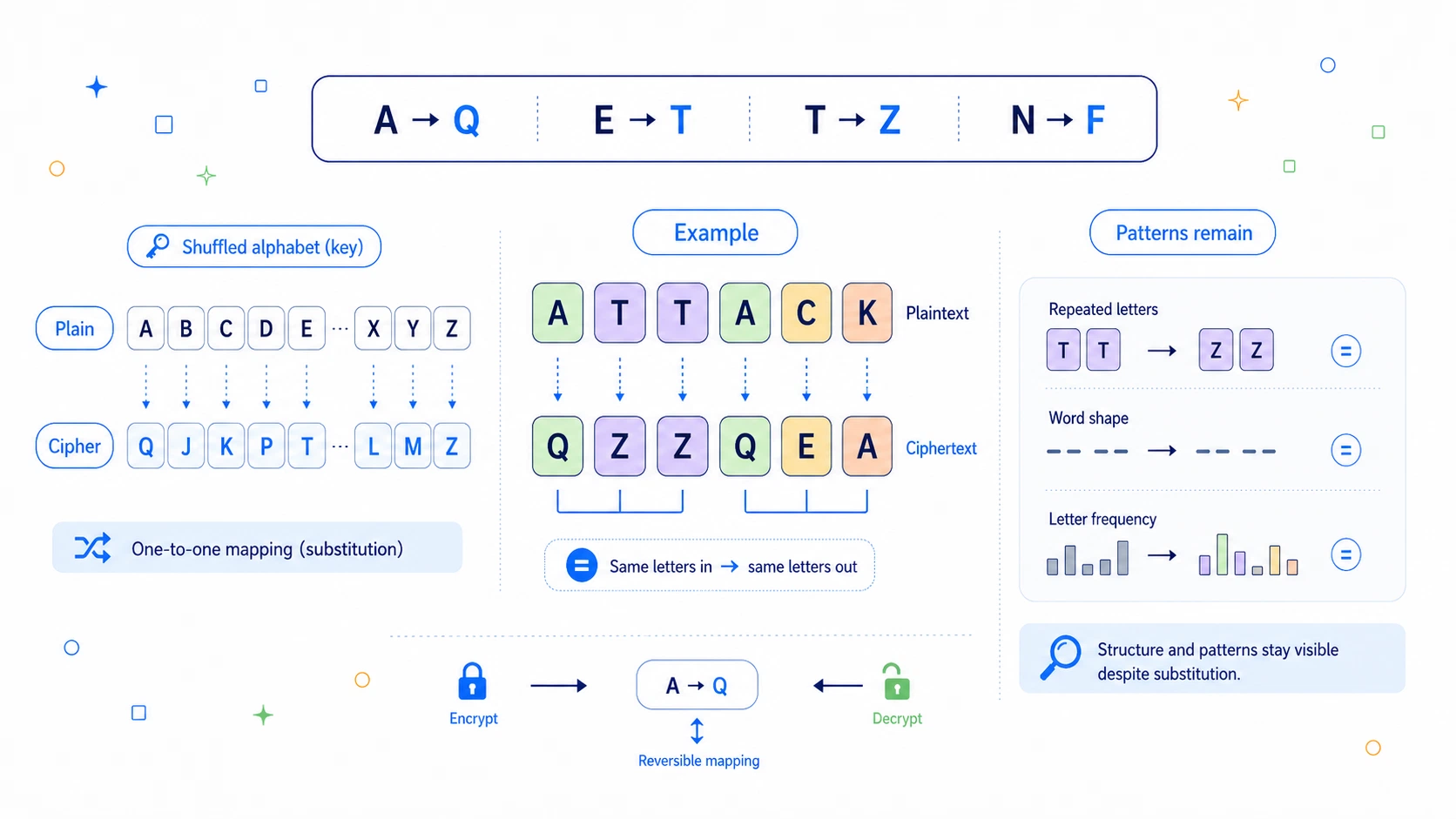
The simple substitution cipher begins with one of the oldest ideas in secret writing: change the letters. Not the order of the message, not the word boundaries, and not the rhythm of the sentence. Just the letters.
A -> Q
B -> W
C -> E
Suddenly an ordinary message seems to vanish behind a second alphabet. That is the charm of the cipher. It is simple enough to understand in a minute, but rich enough to explain a large part of classical cryptography.
Caesar shifts the alphabet. Atbash mirrors it. Keyword ciphers build it from a word. Affine calculates it. The simple substitution cipher says something more general: choose any alphabet you like.
That freedom makes it look much stronger than a Caesar shift. A Caesar cipher has only a handful of possible shifts. A full substitution cipher can use an enormous number of scrambled alphabets.
But the cipher has a problem. It changes the letters, but it does not change the habits of the language underneath. The mask changes; the face still presses through.
That is why the simple substitution cipher is still worth learning. It shows why secrecy is not just about hiding symbols. It is about hiding structure.
Simple Substitution Cipher at a Glance
| Feature | Simple Substitution Cipher |
|---|---|
| Type | Monoalphabetic substitution cipher |
| Main idea | Replace each plaintext letter with a fixed ciphertext letter |
| Standard alphabet | A to Z |
| Key | A complete shuffled cipher alphabet |
| Example key | QWERTYUIOPASDFGHJKLZXCVBNM |
| Example | ATTACK AT DAWN -> QZZQEA QZ RQVF |
| Decryption | Reverse the alphabet mapping |
| Security | Educational only; weak against frequency analysis |
| Best use | Learning substitution, keyspace, pattern leakage, and classical codebreaking |
A simple substitution cipher is often the first point where a beginner sees the difference between a tiny cipher and a serious-looking one.
Caesar uses a shift.
Atbash uses a reversal.
A general substitution cipher uses a whole secret alphabet.
That sounds like a major improvement.
In one sense, it is.
In another sense, it is a trap.
A Secret Alphabet, Not a Shift
A Caesar cipher is easy to describe because it uses a regular movement.
With a Caesar shift of 3:
A -> D
B -> E
C -> F
The whole alphabet slides forward.
A simple substitution cipher does not need to slide at all. It can replace the alphabet with a mixed alphabet:
Plain alphabet:  ABCDEFGHIJKLMNOPQRSTUVWXYZ
Cipher alphabet: QWERTYUIOPASDFGHJKLZXCVBNM
Now the rule is direct lookup.
A becomes Q.
B becomes W.
C becomes E.
D becomes R.
E becomes T.
There is no single shift to find. There is no neat mirror like Atbash. There is no two-number formula like Affine.
There is just a mapping.
That mapping is the key.
If the sender and receiver both know the cipher alphabet, they can encrypt and decrypt the message. If an outsider does not know it, the message looks scrambled.
At least at first.
The Same Letter Always Wears the Same Mask
The simple substitution cipher is monoalphabetic.
That word matters.
It means the cipher uses one substitution alphabet for the whole message. Every plaintext letter keeps the same ciphertext partner from beginning to end.
If the key says:
E -> T
then every E becomes T.
If the key says:
A -> Q
then every A becomes Q.
This is the central strength and the central weakness of the cipher.
It makes the system easy to use by hand. You can write the alphabet pair on a page and work through the message letter by letter.
But it also means patterns survive.
A repeated plaintext letter becomes a repeated ciphertext letter.
A common plaintext letter becomes a common ciphertext letter.
A word shape remains a word shape.
The cipher changes the costume.
It does not change the skeleton.
The Alphabet Pair
The ordinary English version begins with the 26-letter alphabet:
| Plain letter | A | B | C | D | E | F | G | H | I | J | K | L | M |
|---|---|---|---|---|---|---|---|---|---|---|---|---|---|
| Cipher letter | Q | W | E | R | T | Y | U | I | O | P | A | S | D |
| Plain letter | N | O | P | Q | R | S | T | U | V | W | X | Y | Z |
|---|---|---|---|---|---|---|---|---|---|---|---|---|---|
| Cipher letter | F | G | H | J | K | L | Z | X | C | V | B | N | M |
That table is the cipher.
It can also be written more compactly:
Plain:  ABCDEFGHIJKLMNOPQRSTUVWXYZ
Cipher: QWERTYUIOPASDFGHJKLZXCVBNM
To encrypt a letter, look for it in the plain alphabet and take the letter below it.
So:
A -> Q
T -> Z
D -> R
W -> V
N -> F
To decrypt, read the same pair in reverse.
Q -> A
Z -> T
R -> D
V -> W
F -> N
That is the whole mechanism.
It is not complicated.
That is why it was usable.
It is also why the weakness is so exposed.
Worked Example: ATTACK AT DAWN
Let us encrypt:
ATTACK AT DAWN
using the alphabet:
Plain:  ABCDEFGHIJKLMNOPQRSTUVWXYZ
Cipher: QWERTYUIOPASDFGHJKLZXCVBNM
Now substitute each letter.
| Plain letter | Cipher letter |
|---|---|
| A | Q |
| T | Z |
| T | Z |
| A | Q |
| C | E |
| K | A |
| A | Q |
| T | Z |
| D | R |
| A | Q |
| W | V |
| N | F |
Put the result together:
ATTACK AT DAWN
QZZQEA QZ RQVF
So:
ATTACK AT DAWN -> QZZQEA QZ RQVF
This example shows the cipher very clearly.
The message has changed.
But it has not changed enough.
Look at the first word:
ATTACK
QZZQEA
The double T became double Z.
The repeated A appears as repeated Q.
The shape of the word has survived.
That surviving shape is the beginning of the attack.
The Key Must Be Reversible
A substitution alphabet has to be a clean one-to-one mapping.
That means each plaintext letter needs one ciphertext letter, and each ciphertext letter should be used once.
A good 26-letter cipher alphabet looks like this:
QWERTYUIOPASDFGHJKLZXCVBNM
It contains every letter A to Z exactly once.
A bad cipher alphabet might look like this:
QQERTYUIOPASDFGHJKLZXCVBNM
The problem is immediate.
A -> Q
B -> Q
Now imagine the receiver sees the ciphertext letter Q.
Was the original letter A?
Or was it B?
There is no way to know.
That is not a minor inconvenience. It destroys decryption.
A cipher is not just a way of making text look different. It must make text look different in a way that the intended receiver can undo.
That is why a full substitution alphabet must not contain repeated letters.
The rule is simple:
one plaintext letter in, one ciphertext letter out, and a clear path back again.
Random Alphabets, Keyword Alphabets, and Atbash Alphabets
The cipher alphabet can be made in several ways.
A random alphabet might be:
QWERTYUIOPASDFGHJKLZXCVBNM
A keyword alphabet might begin with a word, remove repeated letters, and then append the unused letters.
For example, with the keyword:
ZEBRA
the alphabet starts:
ZEBRA
Then the unused letters are added:
ZEBRACDFGHIJKLMNOPQSTUVWXY
So the full mapping becomes:
Plain:  ABCDEFGHIJKLMNOPQRSTUVWXYZ
Cipher: ZEBRACDFGHIJKLMNOPQSTUVWXY
Atbash is another special case. It simply reverses the alphabet:
Plain:  ABCDEFGHIJKLMNOPQRSTUVWXYZ
Cipher: ZYXWVUTSRQPONMLKJIHGFEDCBA
This is why the simple substitution cipher deserves its own place even if a site already has Caesar, Atbash, Affine, and Keyword tools.
It is the parent idea.
Those other ciphers are more specific ways of building or describing a substitution alphabet.
The simple substitution cipher is the general form.
A Huge Number of Alphabets
A Caesar cipher is small.
In the standard English alphabet, there are only 26 possible shifts, and one of those is the useless shift where every letter remains itself.
A full substitution cipher is much larger.
The first plaintext letter could map to any of 26 ciphertext letters.
The second plaintext letter could then map to any of the remaining 25.
The third has 24 choices.
And so on.
That gives:
26 x 25 x 24 x ... x 2 x 1
This is written as:
$$ 26! $$
The number is:
403,291,461,126,605,635,584,000,000
That is about:
$$ 4.03 \times 10^{26} $$
possible alphabets.
That number is enormous.
It is so large that trying every possible alphabet by brute force is not the natural way to attack the cipher.
And yet the cipher is still weak.
This is one of the most important lessons in classical cryptography.
A large keyspace helps.
But a large keyspace does not save a cipher that leaks too much structure.
The Pattern Still Leaks Through
English is not random.
Some letters appear more often than others. Some pairs appear often. Some words are common. Some word shapes are much more likely than others.
A simple substitution cipher does not erase those habits.
It only renames them.
If E is the most common letter in the plaintext, then the ciphertext symbol standing for E may become the most common symbol in the ciphertext.
If THE appears several times, the same three-letter ciphertext word will appear several times.
If the plaintext contains a doubled letter, the ciphertext will contain a doubled letter in the same place.
That is the problem.
The cipher hides the alphabet.
It does not hide the statistical fingerprint of the language.
For a short message, that may not be enough to break it easily. A three-word message gives the attacker very little material.
But a longer message gives the attacker more and more clues.
The longer the text, the more the language starts to show through the mask.
Why Frequency Analysis Loves This Cipher
Frequency analysis attacks the cipher by counting.
It asks:
which ciphertext letters appear most often?
In English, common letters include E, T, A, O, I, N, S, H, and R. The exact order changes from text to text, but the broad pattern is strong enough to be useful.
If a long ciphertext contains a letter such as X unusually often, the attacker might suspect:
X = E
or:
X = T
That guess might be wrong.
But it gives the attacker a starting point.
Then the attacker looks for short words.
A one-letter word in English is likely to be:
A
I
A common three-letter word might be:
THE
AND
YOU
ARE
A doubled letter might suggest:
LL
SS
EE
OO
TT
The attacker gradually builds the hidden alphabet.
Not all at once.
Piece by piece.
That is what makes substitution solving feel less like testing keys and more like solving a crossword.
The Crossword Inside the Cipher
Suppose a ciphertext contains the repeated word:
ZRC
and it appears in several places.
If the message is English, a repeated three-letter word is often a good place to look.
Could it be THE?
If so:
Z -> T
R -> H
C -> E
Now every Z, R, and C in the ciphertext can be tentatively replaced.
That creates partial words elsewhere.
A partial word like:
T_E
might suggest:
THE
or:
TOE
or something else, depending on the context.
A longer pattern gives better clues.
For example, the word:
QZZQEA
has this repeated structure:
ATTACK
QZZQEA
The first and fourth letters match.
The second and third letters match.
That kind of repeated structure survives substitution exactly.
This is why human solvers can often break substitution ciphers without doing anything that looks like advanced mathematics.
They use language.
They use probability.
They use pattern recognition.
The cipher turns the message into a puzzle, but it does not destroy the puzzle pieces.
When Spaces Make the Job Easier
Preserving spaces makes encrypted text easier to read and share.
It also makes it weaker.
Compare:
QZZQEA QZ RQVF
with:
QZZQEAQZRQVF
The first version reveals the word lengths:
6 / 2 / 4
The second version hides them.
That does not make the second version secure, but it does remove one set of clues.
Classical ciphertext was often grouped into blocks:
QZZQE AQZRQ VF
Grouping has two advantages.
It makes the text easier to copy.
It hides the original word breaks.
But frequency patterns and repeated-letter patterns still remain. Removing spaces makes the attacker work harder. It does not solve the deeper problem.
The same is true of punctuation and case.
Keeping punctuation is convenient.
Removing it is more traditional.
Neither turns simple substitution into modern encryption.
A Cipher with No Single Inventor
The simple substitution cipher does not have one clean origin story.
It is too basic for that.
The idea of replacing one symbol with another appears naturally in the history of secret writing. Once people write with alphabets or symbol systems, the thought of swapping symbols is almost inevitable.
Some specific substitution systems have famous identities.
The Caesar cipher is associated with Julius Caesar.
Atbash belongs to an ancient Hebrew alphabetic tradition.
Keyword ciphers are a practical way of remembering a mixed alphabet.
Affine is a mathematical generalisation.
But the general idea of simple substitution is older and broader than any one named version.
Its importance is not that one inventor had one brilliant moment.
Its importance is that it became one of the basic forms of secrecy.
And then one of the basic forms of codebreaking.
The history of simple substitution is also the history of people learning that language leaves fingerprints.
Why This Cipher Was Useful Anyway
The simple substitution cipher is weak today, but it was not pointless.
It had real practical advantages in the right setting.
| Advantage | Why it mattered |
|---|---|
| Easy to use by hand | A sender only needed the substitution alphabet |
| Easy to teach | The mechanism is just letter replacement |
| More flexible than Caesar | The alphabet does not have to follow a simple shift |
| Good for short casual secrecy | It hides a message from someone who does not know the system |
| Good for puzzles | It creates a solvable but satisfying codebreaking challenge |
| Conceptually important | It introduces keyspace, reversibility, and frequency leakage |
A substitution cipher is the kind of system that can feel powerful before you learn cryptanalysis.
That feeling matters educationally.
It lets the reader experience the first illusion of cryptography:
the message looks unreadable, so it feels secure.
Then frequency analysis breaks the illusion.
That is a valuable lesson.
The Problem Is Not Just Age
It is tempting to say:
the simple substitution cipher is weak because it is old.
That is not quite right.
It is weak because of what it preserves.
A bad modern cipher can fail for the same reason. It can have a complicated-looking process while still leaking patterns, metadata, structure, or predictable relationships.
The substitution cipher is an old example of a general problem.
It does not hide enough.
The attacker does not need to know the original alphabet. The attacker can use the statistical behaviour of the message itself.
That is a deeper weakness than merely being old-fashioned.
The cipher fails because the ciphertext still carries too much of the plaintext's shape.
General Substitution, Caesar, Atbash, Keyword, and Affine
The simple substitution cipher sits at the centre of several related ciphers.
| Cipher | Relationship |
|---|---|
| Caesar Cipher | A substitution cipher where the alphabet is shifted by a fixed number |
| ROT13 | A Caesar shift of 13 |
| Atbash Cipher | A substitution cipher where the alphabet is reversed |
| Keyword Cipher | A substitution cipher where a keyword generates the cipher alphabet |
| Affine Cipher | A substitution cipher generated by a modular arithmetic formula |
| Frequency Analysis | A major attack against monoalphabetic substitution |
| Vigenere Cipher | A polyalphabetic cipher that changes the substitution alphabet as the message progresses |
| Columnar Transposition | Moves letters around instead of replacing them |
This comparison is useful because many beginner ciphers can feel like separate tricks.
They are not separate tricks.
They are variations on a few core ideas.
Substitution changes what the letters are.
Transposition changes where the letters go.
Polyalphabetic substitution changes the substitution rule as the message moves along.
Once you see those categories, classical cryptography becomes much easier to organise.
Recognising Simple Substitution in Practice
A simple substitution ciphertext often looks like ordinary letters arranged into ordinary word lengths:
ZRC JXOEH WKAVF YAB PXDSL ACTK ZRC SQMN RGU
That may look cryptic, but several clues remain visible.
The repeated word ZRC appears twice.
The word lengths are preserved.
There are no strange symbols.
The letter distribution may be uneven.
A practical codebreaker might proceed like this:
- Check whether it could be Caesar, ROT13, or Atbash.
- If not, check whether it still looks monoalphabetic.
- Count letter frequencies.
- Look for one-letter, two-letter, and three-letter words.
- Guess common words such as
THE,AND,TO,OF,IN,THAT. - Build the substitution alphabet gradually.
- Test whether the partial plaintext starts to read like English.
That is the normal attack shape.
The attacker is not trying every alphabet.
The attacker is reading the shadow of the language.
Where Simple Substitution Appears Today
The simple substitution cipher is not used for serious security.
Its modern life is mostly educational and recreational.
You are likely to meet it in:
- classroom cryptography lessons
- puzzle books
- escape rooms
- geocaching clues
- online cipher tools
- programming tutorials
- puzzle hunts
- recreational codebreaking
- ARG-style puzzle culture
- fictional secret-message settings
It belongs near Caesar, Atbash, Morse, binary, A1Z26, and other systems that people use when they want something understandable, visible, and puzzle-like.
It is less instantly iconic than Morse code.
It is less quick than Caesar.
But it is deeper than both as a cryptography lesson.
It gives the reader a real encounter with cryptanalysis.
Not just:
how do I encrypt this?
But:
what did the encryption fail to hide?
That question is the beginning of serious cryptographic thinking.
A Simple Python Substitution Cipher
The simple substitution cipher is also a good programming exercise.
The code below:
- validates the alphabets
- encrypts with a substitution alphabet
- decrypts by reversing the mapping
- preserves spaces and punctuation
- preserves uppercase and lowercase letters
Python exampleShow code
# Simple educational implementation of the Simple Substitution Cipher

ALPHABET = "ABCDEFGHIJKLMNOPQRSTUVWXYZ"


def clean_alphabet(alphabet):
    cleaned = "".join(ch for ch in alphabet.upper() if ch.isalpha())

    if len(cleaned) != 26:
        raise ValueError("Alphabet must contain exactly 26 letters.")

    if len(set(cleaned)) != 26:
        raise ValueError("Alphabet must not contain repeated letters.")

    return cleaned


def make_maps(plain_alphabet, cipher_alphabet):
    plain = clean_alphabet(plain_alphabet)
    cipher = clean_alphabet(cipher_alphabet)

    encrypt_map = dict(zip(plain, cipher))
    decrypt_map = dict(zip(cipher, plain))

    return encrypt_map, decrypt_map


def translate(text, plain_alphabet, cipher_alphabet, mode):
    encrypt_map, decrypt_map = make_maps(plain_alphabet, cipher_alphabet)

    if mode == "encrypt":
        mapping = encrypt_map
    elif mode == "decrypt":
        mapping = decrypt_map
    else:
        raise ValueError("Mode must be 'encrypt' or 'decrypt'.")

    output = []

    for char in text:
        upper = char.upper()

        if upper in mapping:
            mapped = mapping[upper]

            if char.islower():
                output.append(mapped.lower())
            else:
                output.append(mapped)
        else:
            output.append(char)

    return "".join(output)


plain_alphabet = "ABCDEFGHIJKLMNOPQRSTUVWXYZ"
cipher_alphabet = "QWERTYUIOPASDFGHJKLZXCVBNM"

plaintext = "Attack at dawn!"

ciphertext = translate(
    plaintext,
    plain_alphabet,
    cipher_alphabet,
    "encrypt"
)

recovered = translate(
    ciphertext,
    plain_alphabet,
    cipher_alphabet,
    "decrypt"
)

print("Plaintext :", plaintext)
print("Encrypted :", ciphertext)
print("Decrypted :", recovered)
Expected output:
Plaintext : Attack at dawn!
Encrypted : Qzzqea qz rqvf!
Decrypted : Attack at dawn!
This is not production security code.
It is teaching code.
That is exactly what it should be.
Reading the Code Like the Cipher
The most important line is:
encrypt_map = dict(zip(plain, cipher))
That line builds the secret alphabet.
If:
plain  = ABCDEFGHIJKLMNOPQRSTUVWXYZ
cipher = QWERTYUIOPASDFGHJKLZXCVBNM
then Python creates a dictionary like:
{
    "A": "Q",
    "B": "W",
    "C": "E",
    "D": "R",
    # ...
}
That dictionary is the encryption rule.
The decryption rule is the same idea reversed:
decrypt_map = dict(zip(cipher, plain))
So if encryption says:
A -> Q
decryption says:
Q -> A
The validation step is also important:
if len(set(cleaned)) != 26:
    raise ValueError("Alphabet must not contain repeated letters.")
This prevents a broken alphabet from being accepted.
A substitution cipher has to be reversible. Repeated letters in the cipher alphabet would create collisions, and collisions make decryption ambiguous.
The loop then processes the message one character at a time:
for char in text:
Letters are substituted.
Spaces, punctuation, digits, and symbols are left alone.
That is why:
Attack at dawn!
keeps its spaces and exclamation mark.
From a security perspective, preserving spaces leaks structure.
From an educational tool perspective, it makes the output easier to understand.
That is the trade-off.
Common Questions About the Simple Substitution Cipher
Is the simple substitution cipher secure?
No.
It is an educational and recreational cipher, not a secure encryption system. It preserves letter frequencies, repeated patterns, and often word lengths.
It should not be used for passwords, private messages, financial information, API keys, recovery phrases, or personal data.
Why is it stronger than Caesar but still weak?
It is stronger than Caesar because it has vastly more possible alphabets.
Caesar has only a small number of shifts.
A general substitution cipher has 26! possible alphabets.
But it is still weak because it preserves the statistical structure of the language. Frequency analysis and pattern matching can attack it without trying every key.
What is the key?
The key is the cipher alphabet.
For example:
QWERTYUIOPASDFGHJKLZXCVBNM
This tells the sender and receiver how to replace each plaintext letter.
How do you decrypt it?
Use the alphabet mapping in reverse.
If encryption says:
A -> Q
then decryption says:
Q -> A
The receiver uses the cipher alphabet to recover the original plaintext alphabet.
What is the difference between a simple substitution cipher and a keyword cipher?
A keyword cipher is a specific way to create a substitution alphabet.
A simple substitution cipher is the general idea: any valid one-to-one alphabet mapping can be used.
So a keyword cipher is a type of substitution cipher.
What is the difference between substitution and transposition?
Substitution changes the letters.
Transposition changes their positions.
For example, substitution might turn:
HELLO -> ITSSG
Transposition might turn:
HELLO -> HLOEL
The first changes the symbols. The second rearranges them.
Should spaces be removed?
For classical-style ciphertext, spaces are often removed or grouped into blocks.
That hides word lengths and makes the message slightly harder to attack.
But it does not make the cipher secure. The letter-frequency problem remains.
Why does a random alphabet help?
A random alphabet avoids obvious patterns such as Caesar shifts or Atbash reversal.
It is a better substitution key than a predictable alphabet.
But it is still not secure by modern standards because the same plaintext letter always maps to the same ciphertext letter.
The Real Lesson of the Simple Substitution Cipher
The simple substitution cipher should not be used to protect anything serious.
Not passwords.
Not private messages.
Not financial information.
Not API keys.
Not recovery phrases.
Not personal data.
Modern encryption depends on carefully studied algorithms, large keys, randomness, authentication, and resistance to many kinds of attack. A simple substitution cipher has none of that.
But it still earns its place.
It shows why a secret alphabet is not enough.
It shows why repeated patterns matter.
It shows why language itself can attack a cipher.
It shows why a huge number of possible keys does not automatically create real security.
And it shows why classical cryptography is not just a museum of old tricks. It is a clear way to learn the questions that still matter.
What does the ciphertext reveal?
What structure survives?
What can an attacker exploit?
That is the real lesson.
The simple substitution cipher is not strong.
It is revealing.
Every letter wears a mask.
But the language underneath is still breathing.