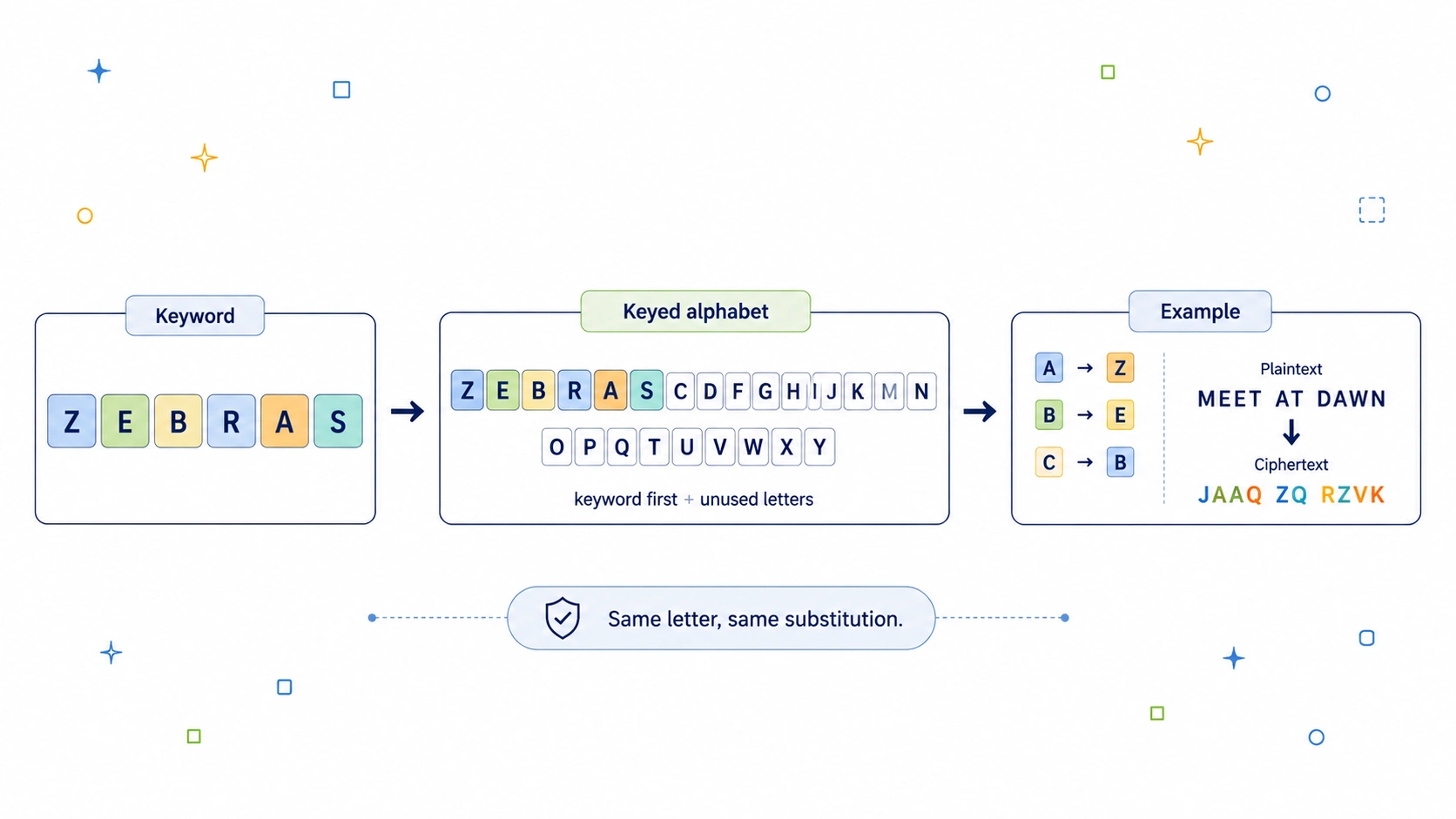
The Keyword Cipher begins with a simple human idea: use a word you can remember. Instead of shifting the alphabet by a fixed number, as in the Caesar cipher, or reversing it completely, as in Atbash, the Keyword Cipher lets a chosen word reshape the alphabet itself.
With the keyword ZEBRAS, the cipher alphabet begins with Z E B R A S. Then the remaining unused letters of the alphabet are added after it: C D F G H I J K L M N O P Q T U V W X Y. The full keyed alphabet becomes ZEBRASCDFGHIJKLMNOPQTUVWXY.
That is the charm of the Keyword Cipher. A single memorable word becomes a complete substitution alphabet. The normal alphabet maps onto this new keyed alphabet, so A becomes Z, B becomes E, C becomes B, and the rest of the alphabet follows the same fixed mapping.
But the weakness remains. The Keyword Cipher is still monoalphabetic: each plaintext letter always becomes the same ciphertext letter. If E becomes A, then every E becomes A. The keyword changes the alphabet, but it does not erase the habits of the language.
That is why the Keyword Cipher is worth learning. It shows how a key can generate a cipher system, while also showing why a hidden alphabet is not the same as real secrecy.
Keyword Cipher at a glance
| Feature | Keyword Cipher |
|---|---|
| Type | Monoalphabetic substitution cipher |
| Main idea | Build a keyed substitution alphabet from a cleaned keyword |
| Key | A word or phrase |
| Example keyword | ZEBRAS |
| Normalised keyword | ZEBRAS |
| Plain alphabet | ABCDEFGHIJKLMNOPQRSTUVWXYZ |
| Keyed alphabet | ZEBRASCDFGHIJKLMNOPQTUVWXY |
| Example plaintext | MEET AT DAWN |
| Example ciphertext | JAAQ ZQ RZVK |
| Decryption method | Reverse the substitution mapping |
| Security level | Educational only; weak by modern standards |
| Best use | Learning substitution, keyed alphabets, and frequency analysis |
The Keyword Cipher builds a keyed substitution alphabet from a cleaned keyword. The keyword is written first, repeated letters are removed, and then the remaining unused letters of the alphabet are added after it.
Once that alphabet exists, encryption is just letter substitution.
Try a quick example
Use the keyword:
ZEBRAS
This creates the keyed alphabet:
ZEBRASCDFGHIJKLMNOPQTUVWXY
Now encrypt:
MEET AT DAWN
Using the normal alphabet above the keyed alphabet:
| Plain | A | B | C | D | E | F | G | H | I | J | K | L | M |
|---|---|---|---|---|---|---|---|---|---|---|---|---|---|
| Cipher | Z | E | B | R | A | S | C | D | F | G | H | I | J |
| Plain | N | O | P | Q | R | S | T | U | V | W | X | Y | Z |
|---|---|---|---|---|---|---|---|---|---|---|---|---|---|
| Cipher | K | L | M | N | O | P | Q | T | U | V | W | X | Y |
So:
| Plain | M | E | E | T | A | T | D | A | W | N |
|---|---|---|---|---|---|---|---|---|---|---|
| Cipher | J | A | A | Q | Z | Q | R | Z | V | K |
The result is:
MEET AT DAWN -> JAAQ ZQ RZVK
What is the Keyword Cipher?
The Keyword Cipher is a classical monoalphabetic substitution cipher. It replaces each plaintext letter with a ciphertext letter from a keyed alphabet.
The keyed alphabet is built from a keyword. For example, the keyword ZEBRAS starts the cipher alphabet:
Z E B R A S
Then the remaining unused alphabet letters are appended in ordinary order:
C D F G H I J K L M N O P Q T U V W X Y
Together, they form:
ZEBRASCDFGHIJKLMNOPQTUVWXY
This keyed alphabet is lined up beneath the normal alphabet:
| Plain alphabet | A | B | C | D | E | F | G | H | I | J | K | L | M |
|---|---|---|---|---|---|---|---|---|---|---|---|---|---|
| Cipher alphabet | Z | E | B | R | A | S | C | D | F | G | H | I | J |
| Plain alphabet | N | O | P | Q | R | S | T | U | V | W | X | Y | Z |
|---|---|---|---|---|---|---|---|---|---|---|---|---|---|
| Cipher alphabet | K | L | M | N | O | P | Q | T | U | V | W | X | Y |
To encrypt, look up the plaintext letter in the top row and write the matching letter from the bottom row. To decrypt, reverse the lookup.
So the keyword is not used as a repeated stream, the way it is in Vigenere. It is used once to build a full substitution alphabet.
How does the Keyword Cipher work?
The Keyword Cipher has three main stages:
- Clean the keyword.
- Build the keyed alphabet.
- Substitute each letter using the keyed alphabet.
Cleaning the keyword means keeping letters, uppercasing them, and removing repeats while preserving the first occurrence. With the keyword:
ZEBRAS
there are no repeated letters, so the cleaned keyword is still:
ZEBRAS
With a keyword such as:
BALLOON
the repeated letters are removed:
BALON
Only the first L and first O remain. The goal is to create a cipher alphabet with each letter appearing exactly once.
Keyword, cleaned keyword, and normalised keyword
The raw keyword is whatever the user types. A tool may accept spaces, punctuation, and mixed case:
Zebras!
The cleaned keyword keeps only letters and converts them to uppercase:
ZEBRAS
The normalised keyword removes repeated letters:
ZEBRAS
For a messier example:
Secret Message!
the cleaned letters are:
SECRETMESSAGE
After removing repeats, the normalised keyword becomes:
SECRTMAG
That normalised keyword starts the cipher alphabet. Then the unused alphabet letters are appended.
Using the CipherRegister Keyword Cipher Tool
The Keyword Cipher tool is built around the same ideas:
| Control | What it does |
|---|---|
| Mode | Encrypt or decrypt |
| Keyword | Builds the keyed substitution alphabet |
| Block size | Groups encrypted output for readability |
| Preserve spacing | Keeps spaces in their original positions |
| Preserve punctuation | Leaves punctuation and numbers visible |
| Output status | Explains the effective alphabet and any warnings |
The important part is the effective keyed alphabet. If the keyword is valid, the tool can show the normalised keyword and the final cipher alphabet.
For the default keyword:
ZEBRAS
the effective keyed alphabet is:
ZEBRASCDFGHIJKLMNOPQTUVWXY
This is the alphabet used for every letter substitution.
Key and rules
| Rule | Explanation |
|---|---|
| Use a keyword | The keyword starts the cipher alphabet |
| Remove repeated letters | Each alphabet letter can appear only once |
| Add unused alphabet letters | Fill the rest of the cipher alphabet in normal order |
| Substitute letter by letter | Each plaintext letter maps to one fixed ciphertext letter |
| Preserve case if desired | A tool can keep uppercase and lowercase style |
| Non-letters may pass through | Spaces, numbers, and punctuation can be preserved |
| Decryption reverses the mapping | Cipher alphabet letters map back to normal alphabet letters |
The Keyword Cipher does not use modular arithmetic. It does not use row and column coordinates. It does not use a repeating keystream.
It uses a keyed alphabet.
That makes it easy to understand and easy to implement.
Worked example: MEET AT DAWN with ZEBRAS
Encrypt:
MEET AT DAWN
using the keyword:
ZEBRAS
First build the keyed alphabet:
Plain:  ABCDEFGHIJKLMNOPQRSTUVWXYZ
Cipher: ZEBRASCDFGHIJKLMNOPQTUVWXY
Now substitute each letter:
| Plain | Cipher |
|---|---|
| M | J |
| E | A |
| E | A |
| T | Q |
| A | Z |
| T | Q |
| D | R |
| A | Z |
| W | V |
| N | K |
So:
MEET AT DAWN -> JAAQ ZQ RZVK
If punctuation is preserved, then:
Meet at dawn! -> Jaaq zq rzvk!
The case style is kept, but the substitution mapping is the same.
Tool options explained
Grouping ciphertext is only formatting. For example:
JAAQZQRZVK
can be grouped as:
JAAQZ QRZVK
The letters have not changed. Only the display has changed.
Preserving spaces makes the output easier to read:
JAAQ ZQ RZVK
Removing spaces makes it look more like traditional ciphertext:
JAAQZQRZVK
Preserving punctuation lets ordinary text remain readable:
Meet at dawn! -> Jaaq zq rzvk!
But from a security point of view, spaces and punctuation leak structure. Word lengths, sentence shapes, and punctuation marks can all help an attacker.
Understanding the output status
A good Keyword Cipher tool should explain what it actually used.
For example:
| Status item | Meaning |
|---|---|
| Cleaned keyword | The letters kept after removing spaces and punctuation |
| Normalised keyword | The keyword after duplicate letters are removed |
| Keyed alphabet | The final cipher alphabet |
| Repeated letters removed | Shows whether the raw keyword changed |
| Empty keyword warning | Explains that at least one usable letter is required |
This is useful because the keyword a user types is not always the keyword the cipher uses.
If someone enters:
ZEBRAS!!!
the effective keyword is still:
ZEBRAS
If someone enters:
banana
the normalised keyword becomes:
BAN
The tool should make that visible.
What leaks from a Keyword Cipher?
The Keyword Cipher hides the direct alphabet order, but it does not hide letter frequency.
English has habits. Some letters appear more often than others. Some pairs and word shapes are common. A monoalphabetic substitution preserves those habits because the mapping is fixed.
If the plaintext letter E is common, then whatever cipher letter represents E will become common too. With the ZEBRAS keyed alphabet, E maps to A, so a long encrypted English message may contain many As.
That gives a codebreaker a way in.
The Keyword Cipher changes the alphabet, but it does not change the statistical shape of the language.
History and origin
Keyword substitution belongs to the long family of simple substitution ciphers. The basic idea is old: replace each plaintext letter with another symbol or letter according to a fixed alphabet.
The keyword version makes that fixed alphabet easier to create and remember. Instead of memorising a random 26-letter substitution alphabet, the sender and receiver can agree on a word or phrase, remove repeated letters, and fill in the rest of the alphabet.
That practicality is the point.
The Keyword Cipher was not designed for modern computer security. It belongs to a world of hand ciphers, puzzles, classrooms, and paper alphabets. Its value is educational: it shows how a small key can generate a larger substitution system.
Why the Keyword Cipher was useful
The Keyword Cipher was useful because it made substitution alphabets more manageable.
| Advantage | Why it helped |
|---|---|
| Memorable key | A word is easier to remember than a random alphabet |
| Simple setup | The alphabet can be built by hand |
| Reversible | Decryption uses the reverse mapping |
| Better than a plain alphabet shift | The mapping is less obvious than Caesar |
| Good for teaching | It shows how a key can generate a substitution alphabet |
Compared with Caesar, the Keyword Cipher has many more possible alphabets. But it is still a fixed substitution cipher.
That means it is only a step forward, not a secure destination.
Weaknesses
The Keyword Cipher is weak by modern standards.
| Weakness | Why it matters |
|---|---|
| Monoalphabetic mapping | Each plaintext letter always maps to the same ciphertext letter |
| Frequency patterns survive | Common letters remain common after substitution |
| Word shapes may leak | Preserved spacing reveals lengths and patterns |
| Human keywords are guessable | People choose memorable words |
| No authentication | It cannot detect tampering |
| Not modern encryption | It lacks secure keys, randomness, and formal security |
The biggest issue is the fixed mapping. If an attacker recovers part of the alphabet, that knowledge applies everywhere in the message.
How the Keyword Cipher is broken
A practical attack usually begins with frequency analysis.
The attacker counts ciphertext letters and compares the counts to normal English. They look for common single letters, repeated patterns, short words, doubled letters, and likely cribs.
For example, if spaces are preserved, a one-letter word is likely to be A or I. A three-letter word may be THE, AND, YOU, or ARE. Repeated patterns can also help.
Suppose a ciphertext contains a repeated word shape:
QAAQ
That shape suggests a plaintext pattern where the middle two letters are the same. It may not solve the message on its own, but every clue narrows the alphabet.
The keyword itself can also be attacked. Human keywords are often words like SECRET, CASTLE, ORANGE, DRAGON, or names and places. If the attacker guesses the keyword, the entire cipher alphabet is recovered.
Common mistakes when using a Keyword Cipher
| Mistake | Why it causes trouble |
|---|---|
| Forgetting to remove duplicates | The cipher alphabet may contain repeated letters |
| Using different alphabet fill rules | Sender and receiver build different alphabets |
| Treating grouping as encryption | Grouping is only display formatting |
| Preserving spaces unintentionally | Word lengths leak information |
| Expecting modern security | The cipher is educational only |
The most important rule is consistency. Both sides must clean the keyword, remove duplicates, and fill the alphabet in the same way.
Keyword Cipher vs Caesar Cipher
| Feature | Caesar Cipher | Keyword Cipher |
|---|---|---|
| Key | Number shift | Word or phrase |
| Alphabet | Shifted alphabet | Keyword-built alphabet |
| Mapping | Fixed | Fixed |
| Type | Monoalphabetic substitution | Monoalphabetic substitution |
| Easy to brute force | Very easy | Harder than Caesar, but still weak |
| Frequency analysis | Works well | Works well |
The Keyword Cipher is more flexible than Caesar because the alphabet is not just shifted by a number. But both ciphers preserve a fixed letter mapping.
That is why frequency analysis still works.
Keyword Cipher vs Vigenere Cipher
| Feature | Keyword Cipher | Vigenere Cipher |
|---|---|---|
| Key use | Builds one substitution alphabet | Selects changing shifts |
| Mapping | One fixed mapping | Mapping changes by key position |
| Cipher type | Monoalphabetic | Polyalphabetic |
| Example key | ZEBRAS | LEMON |
| Main weakness | Letter frequency survives strongly | Repeated-key periodicity leaks structure |
The names can be confusing because both use keywords. But the keyword does different work.
In the Keyword Cipher, the word creates a single alphabet. In Vigenere, the word controls a repeating sequence of shifts.
Related ciphers
| Cipher | Relationship |
|---|---|
| Caesar cipher | A simpler monoalphabetic substitution using a fixed shift |
| Atbash cipher | A fixed alphabet reversal |
| Affine cipher | A formula-based monoalphabetic substitution |
| Vigenere cipher | A polyalphabetic cipher using a repeated keyword |
| Frequency analysis | The main attack against simple substitution ciphers |
The Keyword Cipher is a useful bridge between Caesar and full substitution alphabets. It shows how a key can create a complete alphabet without needing the sender to memorise all 26 substitutions directly.
A simple Python Keyword Cipher
The code below implements a small educational Keyword Cipher. It:
| Feature | Behaviour |
|---|---|
| Cleans the keyword | Keeps letters and uppercases them |
| Removes duplicates | Keeps the first occurrence of each letter |
| Builds the keyed alphabet | Keyword first, then unused letters |
| Encrypts text | Normal alphabet to keyed alphabet |
| Decrypts text | Keyed alphabet back to normal alphabet |
| Preserves non-letters | Spaces, punctuation, and numbers pass through |
| Preserves case | Uppercase and lowercase style are kept |
Python exampleShow code
ALPHABET = "ABCDEFGHIJKLMNOPQRSTUVWXYZ"


def clean_keyword(keyword):
    """
    Keep letters only, uppercase them, and remove duplicates.
    """
    cleaned = ""
    seen = set()

    for char in keyword.upper():
        if char.isalpha() and char not in seen:
            seen.add(char)
            cleaned += char

    if cleaned == "":
        raise ValueError("Keyword must contain at least one letter.")

    return cleaned


def build_cipher_alphabet(keyword):
    """
    Build the keyed substitution alphabet.

    Example:
        ZEBRAS -> ZEBRASCDFGHIJKLMNOPQTUVWXY
    """
    cleaned = clean_keyword(keyword)
    cipher_alphabet = cleaned

    for letter in ALPHABET:
        if letter not in cipher_alphabet:
            cipher_alphabet += letter

    return cipher_alphabet


def make_maps(keyword):
    """
    Build encryption and decryption lookup dictionaries.
    """
    cipher_alphabet = build_cipher_alphabet(keyword)

    encrypt_map = {}
    decrypt_map = {}

    for plain, cipher in zip(ALPHABET, cipher_alphabet):
        encrypt_map[plain] = cipher
        decrypt_map[cipher] = plain

    return encrypt_map, decrypt_map


def transform(text, lookup):
    """
    Transform text using a substitution lookup.
    """
    output = []

    for char in text:
        if char.isalpha():
            upper = char.upper()
            mapped = lookup[upper]

            if char.isupper():
                output.append(mapped)
            else:
                output.append(mapped.lower())
        else:
            output.append(char)

    return "".join(output)


def encrypt(text, keyword):
    """
    Encrypt text with the Keyword Cipher.
    """
    encrypt_map, decrypt_map = make_maps(keyword)
    return transform(text, encrypt_map)


def decrypt(text, keyword):
    """
    Decrypt text with the Keyword Cipher.
    """
    encrypt_map, decrypt_map = make_maps(keyword)
    return transform(text, decrypt_map)


# Example
keyword = "ZEBRAS"
plaintext = "Meet at dawn!"

ciphertext = encrypt(plaintext, keyword)
decrypted = decrypt(ciphertext, keyword)

print("Keyword   :", keyword)
print("Alphabet  :", build_cipher_alphabet(keyword))
print("Plaintext :", plaintext)
print("Encrypted :", ciphertext)
print("Decrypted :", decrypted)
Expected output:
Keyword   : ZEBRAS
Alphabet  : ZEBRASCDFGHIJKLMNOPQTUVWXY
Plaintext : Meet at dawn!
Encrypted : Jaaq zq rzvk!
Decrypted : Meet at dawn!
The key line is:
cipher_alphabet = cleaned
followed by:
for letter in ALPHABET:
    if letter not in cipher_alphabet:
        cipher_alphabet += letter
That is the whole alphabet-building step. The keyword starts the alphabet, and the unused letters complete it.
Reading the code like the cipher
The function clean_keyword(keyword) turns a raw keyword into the usable keyword. If the user enters:
Zebras!
the cleaned keyword becomes:
ZEBRAS
The function build_cipher_alphabet(keyword) then appends every unused alphabet letter:
ZEBRASCDFGHIJKLMNOPQTUVWXY
The function make_maps(keyword) creates two dictionaries:
| Map | Direction |
|---|---|
encrypt_map |
Plain alphabet to keyed alphabet |
decrypt_map |
Keyed alphabet to plain alphabet |
Encryption and decryption use the same substitution engine. Only the lookup map changes.
That is exactly how the cipher works by hand.
Common questions about the Keyword Cipher
Is the Keyword Cipher secure?
No. The Keyword Cipher is not secure by modern standards. It is a monoalphabetic substitution cipher, so frequency analysis and crib-based attacks work against it.
It is useful for learning, puzzles, and historical interest only.
Is the Keyword Cipher the same as Caesar?
No. Caesar uses a numeric shift. The Keyword Cipher uses a word or phrase to build a full substitution alphabet.
But both are monoalphabetic substitution ciphers, so both preserve fixed letter mappings.
What happens if the keyword has repeated letters?
Repeated letters are removed after their first occurrence.
For example:
BALLOON -> BALON
The cipher alphabet must contain each letter only once.
Can spaces and punctuation be preserved?
Yes. A tool can preserve spaces, punctuation, numbers, and case for readability.
But preserving them leaks structure. Classical ciphertext often removes or groups spacing to reduce those clues.
What is a good Keyword Cipher example?
| Item | Value |
|---|---|
| Keyword | ZEBRAS |
| Keyed alphabet | ZEBRASCDFGHIJKLMNOPQTUVWXY |
| Plaintext | MEET AT DAWN |
| Ciphertext | JAAQ ZQ RZVK |
This is the example used in the Keyword Cipher tool.
Is a keyword the same as a key?
In this cipher, yes. The keyword is the key material used to build the substitution alphabet.
But the final effective key is really the full keyed alphabet, because that is what controls every letter mapping.
Why the Keyword Cipher still matters
The Keyword Cipher should not be used to protect anything serious. Not passwords. Not private messages. Not financial data. Not API keys. Not recovery phrases.
Modern encryption depends on carefully analysed algorithms, large keys, secure randomness, authentication, and resistance to many kinds of attack. The Keyword Cipher has none of that.
But it still earns its place.
It shows how a memorable key can generate a larger cipher system. It shows why removing duplicate key letters matters. It shows how substitution alphabets are built. It shows why fixed mappings leak language patterns. It shows why frequency analysis is so powerful.
And most importantly, it teaches that a key is not magic by itself.
A keyword can make the alphabet look secret. It can make the cipher feel more personal and more flexible than Caesar. But if the mapping stays fixed, the language still leaves fingerprints.
That is why the Keyword Cipher still matters. Not because it is strong, but because it teaches the difference between a hidden alphabet and a secure cipher.
Try the Keyword Cipher tool
Use the Keyword Cipher tool to build a keyed alphabet from your own word, encrypt a short message, and inspect the effective alphabet the tool creates.
Start with:
| Setting | Value |
|---|---|
| Keyword | ZEBRAS |
| Plaintext | MEET AT DAWN |
| Expected ciphertext | JAAQ ZQ RZVK |
Then try a keyword with repeated letters, such as BALLOON, and notice how the tool normalises it before building the alphabet.