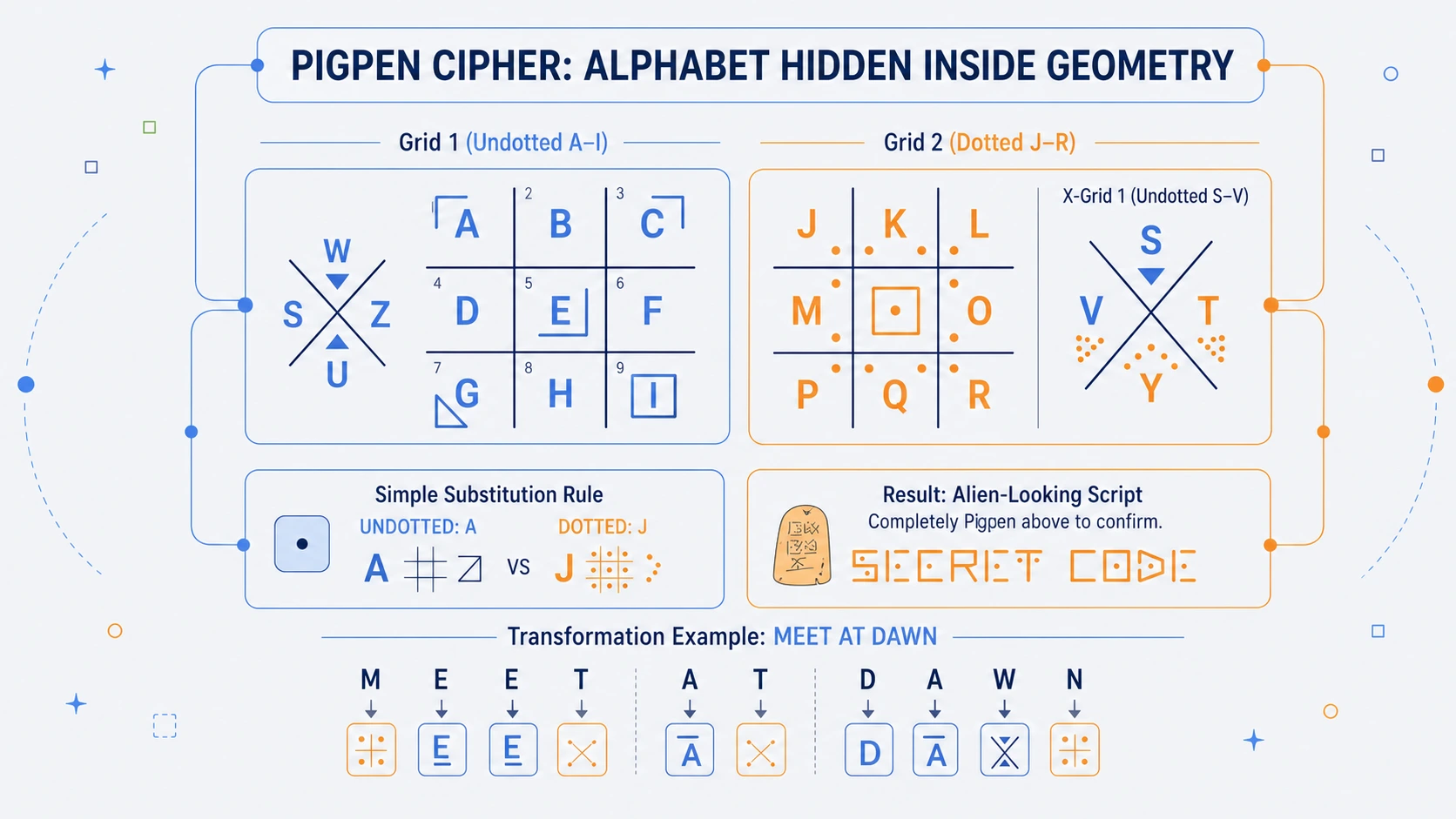
Some ciphers disguise a message by turning one letter into another. Pigpen does something more theatrical: it makes the letters disappear. An A becomes a corner, a B becomes a three-sided enclosure, and other letters become boxes, wedges, and dotted fragments of a larger pattern. The result resembles an unfamiliar script—something carved into stone, copied from a secret society's notebook, or discovered at the edge of a treasure map.
Underneath that visual transformation, however, the mechanism is extremely simple. Pigpen is a monoalphabetic substitution cipher. Every plaintext letter is replaced by one fixed symbol, and the same symbol always decodes to the same letter. No arithmetic is required, no long keyword repeats across the message, and no machinery turns rotors or rearranges columns. Instead, the alphabet is written inside a collection of grids. To encipher a letter, draw the part of the grid surrounding it; dots distinguish one set of letters from another.
The geometry makes Pigpen memorable and gives it an air of mystery that Caesar, Atbash, and ordinary substitution alphabets rarely possess. But appearance is not security. Once the grid is known, the strange symbols become ordinary letters almost immediately.
Pigpen is one of the clearest demonstrations that a message can look completely alien while remaining cryptographically simple.
Pigpen Cipher at a Glance
| Feature | Pigpen Cipher |
|---|---|
| Type | Geometric monoalphabetic substitution cipher |
| Also called | Masonic cipher, Freemason's cipher, Pig Pen cipher, and tic-tac-toe cipher |
| Main idea | Replace each letter with the lines surrounding its position in a grid |
| Alphabet structure | Two nine-letter grids and two four-letter X-shaped grids |
| Key | The diagram assigning letters to grid positions |
| Dot rule | Dots distinguish the second set of symbols from the first |
| Example | MEET AT DAWN becomes a sequence of corners, enclosures, and dotted symbols |
| Decryption | Match each symbol to the corresponding position in the key |
| Security | Very weak; the standard alphabet is directly readable once recognised |
| Best use | Puzzles, classroom activities, geocaching, escape rooms, and learning substitution ciphers |
What Is the Pigpen Cipher?
The Pigpen cipher is a simple substitution cipher in which letters are replaced by geometric symbols. An ordinary substitution might turn A into Q, B into M, and C into Z; the encrypted message still looks like a line of letters, even though those letters have been reassigned. Pigpen replaces the letters with pieces of a diagram instead.
The usual alphabet is divided across four shapes:
| Letter group | Diagram | Distinguishing mark |
|---|---|---|
A–I |
First tic-tac-toe-style grid | None |
J–R |
Second tic-tac-toe-style grid | Dot |
S–V |
First X-shaped grid | None |
W–Z |
Second X-shaped grid | Dot |
The second square grid and second X repeat the geometry of the first pair, but their symbols contain dots. That creates 26 distinguishable signs from a small collection of corners and wedges.
Pigpen is therefore not a separate language or naturally developed writing system. It is a visual way of displaying a substitution alphabet. Its value is not serious secrecy—it offers none—but the clarity with which it demonstrates three fundamental ideas:
- A symbol can stand for a letter.
- A key defines the relationship between plaintext and ciphertext.
- Changing the appearance of symbols does not necessarily hide the patterns of a language.
The Alphabet Becomes Architecture
Most ciphers begin with an operation. Caesar shifts, Atbash reverses, and Vigenère combines each letter with a repeating key. Pigpen begins with a drawing.
Imagine writing the first nine letters into a three-by-three grid:
A B C
D E F
G H I
Now ignore the letters and look only at the lines around each position. A sits in the upper-left region. In the traditional open grid, that position is bordered on its right and below, so its symbol is a corner. B sits in the upper-middle region and is bordered on the left, right, and below. E sits in the centre and is surrounded on all four sides, so its symbol is a small box.
Each grid position produces a different fragment of the larger structure. The next nine letters occupy an identical grid:
J K L
M N O
P Q R
They use the same nine basic shapes, but every symbol receives a dot. The result is nine undotted grid symbols for A–I and nine dotted grid symbols for J–R.
The remaining eight letters occupy two X-shaped diagrams. The first places S at the top, T at the right, U at the bottom, and V at the left. The second repeats those four wedges with dots for W, X, Y, and Z.
The complete alphabet is built from only two questions:
- Where is the letter positioned?
- Does its symbol contain a dot?
That is the Pigpen cipher in full.
Why the Dots Matter
The first and second square grids have identical geometry. Without another marker, A and J would share one symbol, B and K another, and every position would be ambiguous. The dot solves that problem.
- An undotted upper-left corner represents
A. - The same corner with a dot represents
J. - An undotted central box represents
E. - A dotted central box represents
N. - An undotted upper wedge represents
S. - A dotted upper wedge represents
Win the mapping used by the CipherRegister tool.
This is a compact design. Pigpen creates 26 symbols without requiring 26 unrelated drawings. Instead, it combines a small set of geometric shapes with a binary distinction between dotted and undotted forms.
In modern language, the dot carries an extra piece of identifying information. Pigpen was not designed using information theory, of course, but the mark performs a recognisably information-like function: it separates two otherwise identical possibilities.
The Pigpen Key and Its Rules
The key is the diagram showing which letters occupy which grid positions. For the standard mapping used by the CipherRegister tool, A–I occupy the first square grid, J–R repeat those positions with dots, S–V occupy the first X, and W–Z repeat the X positions with dots.
One symbol always represents one letter
Pigpen is monoalphabetic. If M is represented by a particular dotted shape at the beginning of a message, every other M uses that same symbol.
Spaces may be preserved
Traditional handwritten messages often preserve spaces because they make the text easier for the intended reader to decode. That convenience also helps an attacker by revealing word boundaries and word lengths.
Punctuation and numbers are not part of the standard alphabet
The traditional system covers the 26 letters A–Z. Modern tools may preserve punctuation and numbers as ordinary characters, remove them, or extend the system with custom symbols. CipherRegister preserves them unless the user changes the formatting options.
Uppercase and lowercase normally share symbols
Pigpen does not traditionally distinguish between capital and lowercase letters. Both A and a use the same geometric sign.
Variants exist
There is no law of nature requiring A to occupy the first grid position. Historical, regional, and puzzle-specific versions may alter the letter order, rotate symbols, use different grids, or assign the X-shaped letters differently. The mechanism remains the same, but the exact key must match the message being decoded.
Recognising something as Pigpen-like does not therefore guarantee that the most familiar modern alphabet will decode it correctly.
A Worked Example: MEET AT DAWN
Let us encode:
MEET AT DAWN
Step 1: Find each letter in the key
The message contains:
M E E T A T D A W N
Each letter belongs to one of the four diagram groups.
| Letter | Group | Position | Dot? |
|---|---|---|---|
M |
Second square grid | Middle-left | Yes |
E |
First square grid | Centre | No |
E |
First square grid | Centre | No |
T |
First X | Right section | No |
A |
First square grid | Upper-left | No |
T |
First X | Right section | No |
D |
First square grid | Middle-left | No |
A |
First square grid | Upper-left | No |
W |
Second X | Upper section | Yes |
N |
Second square grid | Centre | Yes |
Step 2: Draw the surrounding geometry
For each letter, draw the lines surrounding its position. M becomes the dotted middle-left grid shape. E becomes a complete undotted box, and the second E repeats that box. T becomes the right section of the X. A becomes the upper-left grid corner, D the middle-left undotted grid shape, W the dotted upper X section, and N a dotted box.
Step 3: Preserve the spaces
The word pattern remains:
4–2–4
The ciphertext contains four symbols, then two, then four. This makes the result easier to read, but it also leaks structure.
What the example reveals
The two Es in MEET produce the same symbol twice. The two Ts produce matching symbols, and the two As also match. Pigpen changes the visible alphabet, but it does not remove repetition.
A codebreaker may not initially know what those repeated symbols mean, but they can still see that the first word follows this pattern:
1–2–2–3
That pattern could correspond to words such as MEET, FEEL, SEEN, TOOT, or ROOM. The symbols conceal the letter identities; they do not conceal the shape of the word.
How to Decode Pigpen Symbols
Decryption reverses the lookup process. For every ciphertext symbol:
- Identify whether it comes from a square grid or an X.
- Identify its orientation or position.
- Check whether it contains a dot.
- Find the matching letter in the key.
A small box without a dot represents E; the same box with a dot represents N. A right-facing wedge from the X represents T without a dot and X with one in the standard mapping used here.
Once the key is visible, decryption is almost mechanical. The reader is not solving an equation or reconstructing a keyword; they are matching shapes to locations.
This is why the clickable decoder in the CipherRegister tool is useful. Someone who finds Pigpen in a photograph, handwritten puzzle, or gravestone cannot necessarily paste the symbols into an ordinary text box. Instead, they can select each matching shape from the visual alphabet and reconstruct the plaintext one symbol at a time.
Is It a Cipher or an Alphabet?
Pigpen is sometimes called the Masonic alphabet or Freemason alphabet. That name is understandable, but slightly misleading. An alphabet such as Latin, Greek, or Cyrillic is a writing system used directly to represent language. Pigpen is normally a fixed transformation of another alphabet: the underlying letters are still A–Z; their visible forms have merely been replaced.
Cryptographically, it is a substitution cipher. Typographically, however, Pigpen can behave almost like a font. A Pigpen font may store ordinary Latin letters underneath while displaying geometric symbols on screen.
That distinction matters on computers. Pigpen does not have a widely used set of dedicated Unicode characters that can be exchanged as ordinary text in the way that Latin or Greek letters can. Discussion in the Unicode community has treated Pigpen primarily as a cipher or font representation of Latin letters rather than as an independent script needing its own alphabetic code points.
Online Pigpen tools therefore commonly use custom fonts, SVG drawings, canvas graphics, or images. CipherRegister renders each symbol as SVG geometry, keeping it sharp at different sizes and allowing an encoded message to be exported as SVG or PNG.
The ciphertext may look like writing. Technically, it is often a collection of drawings.
A Cipher with an Uncertain Beginning
Pigpen has accumulated many origin stories. It has been linked to Hebrew mysticism, Rosicrucians, the Knights Templar, pirates, and secret societies. Some accounts point to earlier grid-based symbolic systems that resemble later Pigpen designs.
The safest historical conclusion is more modest. The cipher's precise origin is uncertain, but recognisable variants were firmly associated with Freemasonry by the eighteenth century. Freemasons used geometric ciphers for records, ritual material, and correspondence, which is why Pigpen became known as the Masonic or Freemason's cipher.
The association became strong enough for the symbols to act as more than a secrecy device. They also became a visual marker of membership, tradition, and shared knowledge. To someone who knew the key, an inscription was readable. To someone outside the group, it looked esoteric.
That social boundary may have mattered almost as much as the cryptographic one.
Secret Writing in Stone
One of Pigpen's most evocative historical uses appears on gravestones. The best-known example is associated with James Leeson, who died in 1794 and was buried at Trinity Churchyard in New York. A Pigpen-style inscription on the stone decodes as:
REMEMBER DEATH
The wording is a form of memento mori: a reminder that death comes for everyone. The grave uses a historical variant rather than necessarily matching every modern chart. BabelStone's reconstruction treats it as a 24-letter eighteenth-century alphabet in which I/J and U/V are not distinguished.
Pigpen suits stone particularly well. Its symbols are angular, compact, easy to carve, visually striking, and suggestive of architectural or ritual markings. An ordinary alphabetic cryptogram might simply look misspelled; Pigpen looks intentional. It announces the presence of a secret before the reader has decoded a single letter.
Why Pigpen Was Useful
Pigpen is weak by modern standards, but weak does not mean pointless. In a world without smartphones, searchable cipher databases, and instant image recognition, it offered several practical advantages.
It was easy to draw
The symbols consist mostly of straight lines and dots. They can be written with a pen, scratched into wood, or carved into stone.
The key was easy to remember
A user did not need to memorise 26 unrelated substitutions. They needed to remember two square grids, two X-shaped grids, the ordering of the letters, and which groups use dots. The structure generates the alphabet.
It looked unfamiliar
A message made from corners and wedges does not immediately look like an English substitution cipher. To an uninitiated observer, it may resemble an unknown script, mathematical notation, or ritual symbolism.
It reinforced group knowledge
A shared cipher can function as a badge of membership. Knowing how to read the symbols demonstrates that the reader possesses the same key or training as the writer.
It was sufficient for low-stakes secrecy
Not every secret needs to survive a professional cryptanalyst. For informal notes, private records, inscriptions, games, or ceremonial use, a simple barrier may have been enough to deter the merely curious.
The cipher's usefulness depended on context. It was never Enigma, and it did not need to be. Sometimes the goal was not to withstand a national intelligence service; it was to stop the nearest uninformed reader from understanding the page at a glance.
The Illusion of an Unknown Language
Pigpen's visual unfamiliarity creates a psychological effect. When people see ordinary substitution ciphertext such as:
QXXF QX WQCY
they can immediately tell that it is made from letters. They may not know the mapping, but they recognise the category of the object. Pigpen removes that clue. Its symbols can look like fragments of diagrams, occult signs, architectural marks, an invented alphabet, or a message from another language.
That appearance can cause people to overestimate its security. Cryptography does not measure secrecy by how strange the ciphertext looks. The important questions are structural:
- Does the same plaintext letter always produce the same symbol?
- Are word spaces preserved?
- Are repeated words visible?
- Is the key standard or easily recognised?
- Can language statistics still be measured?
For standard Pigpen, the answers are bad from a security perspective. The message looks transformed; its underlying structure is barely transformed at all.
Pigpen's Main Weaknesses
| Weakness | Why it matters |
|---|---|
| The standard key is widely known | Once Pigpen is recognised, the message can often be read directly |
| Monoalphabetic substitution | Every occurrence of a letter uses the same symbol |
| Repeated patterns survive | Double letters and repeated words remain visible |
| Word lengths often survive | Spaces reveal the shape of sentences |
| Letter frequencies survive | Common plaintext letters produce common ciphertext symbols |
| Variants are still substitutions | Changing the alphabet may slow recognition but does not remove statistical leakage |
| Visual complexity is superficial | Strange-looking symbols do not create mathematical security |
The most severe weakness is that standard Pigpen often does not need to be broken at all. It only needs to be recognised. An attacker who sees the familiar grid fragments and dots can retrieve or reconstruct the alphabet and translate the message directly.
This is closer to reading an unfamiliar font than attacking a serious encryption system.
How Pigpen Is Broken
Step 1: Recognise the symbol family
Pigpen commonly contains right-angled corners, three-sided grid shapes, boxes, V-shaped wedges, and dotted versions of those shapes. That combination is highly distinctive.
Step 2: Try the standard key
Because the best-known Pigpen mapping is public, an attacker can compare the symbols with a standard alphabet chart. If readable language appears, the message is solved.
Step 3: Test common variants
If the standard alphabet produces nonsense, the message may use a different letter order, rotated or reflected symbols, a different X ordering, a 24-letter historical alphabet, a keyword-based alphabet, or a completely shuffled substitution.
Step 4: Use word patterns
Even without the key, the symbols preserve useful structures. A three-letter word with the pattern:
A–B–A
might represent DID, EYE, GAG, POP, or TUT. A one-symbol word is probably A or I. A common three-symbol word with three different symbols might be THE, AND, or FOR. A four-symbol pattern such as A–B–B–C might represent MEET, SEEN, or FEEL.
Step 5: Count symbol frequencies
In a long message, some symbols appear much more often than others. Those may correspond to common English letters such as E, T, A, O, I, and N. Frequency analysis does not automatically reveal the answer—especially in a short text—but it narrows the possibilities.
Step 6: Use probable words
Context provides clues. A gravestone may contain DEATH, MEMORY, BORN, DIED, or REST. A geocaching clue may contain NORTH, TREE, BRIDGE, LEFT, or METRES. Once several symbol-to-letter relationships are guessed, the rest of the substitution begins to unravel.
What If the Alphabet Is Shuffled?
A puzzle creator can make Pigpen less immediately readable by changing which letters occupy the grid. Instead of the ordinary alphabet:
ABCDEFGHIJKLMNOPQRSTUVWXYZ
the key might use:
QWERTYUIOPASDFGHJKLZXCVBNM
The geometric symbols remain the same, but their letter assignments change. This defeats direct lookup with the standard chart, yet it does not make the cipher modern or secure.
The result is essentially a general monoalphabetic substitution cipher written with geometric symbols. It can still be attacked through frequencies, repeated-letter patterns, word lengths, probable words, known plaintext, and language scoring. A custom mapping creates a more substantial puzzle; it does not create strong encryption.
This is also why a custom Pigpen message must share its key with the intended recipient. Without the same alphabet arrangement, the receiver cannot know whether the upper-left symbol means A, Q, Z, or something else.
Pigpen Compared with Related Ciphers
| Cipher | Relationship to Pigpen |
|---|---|
| Substitution Cipher | Pigpen is a substitution cipher that uses geometric symbols instead of a scrambled Latin alphabet |
| Caesar Cipher | Caesar shifts letters by a fixed amount; Pigpen replaces them according to grid positions |
| Atbash Cipher | Atbash reverses the alphabet; Pigpen changes its visible symbol system |
| A1Z26 | A1Z26 replaces letters with numbers; Pigpen replaces them with shapes |
| Morse Code | Morse uses sequences of dots and dashes designed for signalling; Pigpen uses static geometric symbols |
| Dancing Men Cipher | Both replace letters with pictorial signs, but their symbol families and cultural histories differ |
| Templar-style ciphers | Some use related geometric ideas, but their keys and historical claims should not be treated as automatically identical |
| General monoalphabetic substitution | A custom Pigpen alphabet is an ordinary substitution key displayed through geometry |
Pigpen is particularly close in spirit to Arthur Conan Doyle's Dancing Men cipher. Both exploit the same psychological effect: a row of unfamiliar pictures can seem like an unknown language even when it is only English wearing a disguise.
Where Pigpen Appears Today
Pigpen is no longer used for meaningful digital security. Its modern life is recreational and educational. You are most likely to encounter it in:
- Puzzle books and puzzle hunts.
- Geocaching and treasure hunts.
- Escape rooms and mystery games.
- Classroom cryptography lessons.
- Scout and youth-group activities.
- Handmade secret notes.
- Decorative engravings.
- Online decoding challenges.
Educational organisations still use Pigpen as an introduction to encryption because its mechanism is immediate and visual. It demonstrates substitution without requiring modular arithmetic or programming knowledge.
It is also well suited to physical puzzles. A Caesar ciphertext can be typed anywhere; Pigpen feels more like an object. It can be drawn on a wall, cut into a wooden panel, printed on a clue card, or hidden inside an illustration. The symbols invite interaction. The reader wants to find the chart, trace the shapes, and make the message speak.
Why Pigpen Works So Well in Puzzles
Good puzzle ciphers need a delicate balance. If a cipher is too difficult, players become stuck. If it is too easy, there is no satisfying moment of discovery. Pigpen often occupies the right middle ground.
At first, the symbols look opaque. Then the player notices repeated shapes, dots, corners from a square grid, and wedges from an X. The key idea becomes visible. Once the player reconstructs the diagram, the message can be translated by hand.
The difficulty collapses suddenly, producing the sequence puzzle designers want:
confusion → recognition → fluency
Pigpen is not remembered because it is a strong cipher. It is remembered because it creates a good revelation.
A Simple Python Pigpen Encoder
Pigpen presents a small programming problem: its symbols do not have a standard, universally supported plain-text representation. A complete visual implementation therefore needs to draw the geometry with SVG, canvas, images, or a custom font.
The educational program below focuses on the underlying mapping. It converts letters into descriptive Pigpen tokens. Each token identifies the diagram family, position, and whether the symbol has a dot.
Python exampleShow code
# Educational Pigpen cipher mapping.
# The tokens describe the symbols rather than drawing them.

from string import ascii_uppercase

SQUARE_POSITIONS = [
    "TOP-LEFT",
    "TOP-MIDDLE",
    "TOP-RIGHT",
    "MIDDLE-LEFT",
    "CENTRE",
    "MIDDLE-RIGHT",
    "BOTTOM-LEFT",
    "BOTTOM-MIDDLE",
    "BOTTOM-RIGHT",
]

X_POSITIONS = [
    "TOP",
    "RIGHT",
    "BOTTOM",
    "LEFT",
]


def build_pigpen_key() -> dict[str, str]:
    """Return the standard A-Z Pigpen mapping."""
    mapping: dict[str, str] = {}

    # A-I: first undotted square grid
    for letter, position in zip(ascii_uppercase[0:9], SQUARE_POSITIONS):
        mapping[letter] = f"GRID:{position}"

    # J-R: second square grid, distinguished by a dot
    for letter, position in zip(ascii_uppercase[9:18], SQUARE_POSITIONS):
        mapping[letter] = f"GRID:{position}:DOT"

    # S-V: first undotted X
    for letter, position in zip(ascii_uppercase[18:22], X_POSITIONS):
        mapping[letter] = f"X:{position}"

    # W-Z: second X, distinguished by a dot
    for letter, position in zip(ascii_uppercase[22:26], X_POSITIONS):
        mapping[letter] = f"X:{position}:DOT"

    return mapping


PIGPEN_KEY = build_pigpen_key()
REVERSE_KEY = {symbol: letter for letter, symbol in PIGPEN_KEY.items()}


def encrypt_pigpen(text: str) -> list[str]:
    """Convert text into Pigpen symbol descriptions."""
    result: list[str] = []

    for character in text.upper():
        if character in PIGPEN_KEY:
            result.append(PIGPEN_KEY[character])
        elif character == " ":
            result.append("SPACE")
        else:
            result.append(f"LITERAL:{character}")

    return result


def decrypt_pigpen(tokens: list[str]) -> str:
    """Convert Pigpen symbol descriptions back into text."""
    result: list[str] = []

    for token in tokens:
        if token == "SPACE":
            result.append(" ")
        elif token.startswith("LITERAL:"):
            result.append(token.removeprefix("LITERAL:"))
        elif token in REVERSE_KEY:
            result.append(REVERSE_KEY[token])
        else:
            raise ValueError(f"Unknown Pigpen token: {token}")

    return "".join(result)


plaintext = "MEET AT DAWN"
ciphertext = encrypt_pigpen(plaintext)
recovered = decrypt_pigpen(ciphertext)

print("Plaintext:")
print(plaintext)

print("\nPigpen tokens:")
print(" | ".join(ciphertext))

print("\nDecrypted:")
print(recovered)
Expected result
The token sequence begins:
GRID:MIDDLE-LEFT:DOT
GRID:CENTRE
GRID:CENTRE
X:RIGHT
and the program finishes by recovering:
MEET AT DAWN
The production CipherRegister tool performs the same logical mapping but draws the corresponding lines and dots as SVG symbols.
Reading the Code Like the Cipher
The program follows the physical construction of the Pigpen alphabet. First, it names the nine positions in a square grid:
SQUARE_POSITIONS = [
    "TOP-LEFT",
    "TOP-MIDDLE",
    # ...
]
The first loop pairs A–I with those positions:
for letter, position in zip(ascii_uppercase[0:9], SQUARE_POSITIONS):
The second loop repeats the positions for J–R but adds DOT:
mapping[letter] = f"GRID:{position}:DOT"
That line corresponds directly to Pigpen's visual rule: use the same shape, but add a dot for the second alphabet group. The two X loops follow the same pattern for S–Z.
Encryption is then only a lookup:
result.append(PIGPEN_KEY[character])
Decryption uses the reversed dictionary:
REVERSE_KEY = {symbol: letter for letter, symbol in PIGPEN_KEY.items()}
This is the important insight. Pigpen feels visual and mysterious, but its computational core is a dictionary mapping. The geometry affects how the result is displayed; the cryptographic transformation is one-to-one substitution.
Common Questions About the Pigpen Cipher
Is the Pigpen cipher secure?
No. Standard Pigpen is extremely weak because the key is widely known. Once the symbol system is recognised, a message can often be translated directly. Even with a custom alphabet, Pigpen remains a monoalphabetic substitution cipher and leaks frequencies, repeated letters, word patterns, and sentence structure.
It should not be used for passwords, private data, or serious communication.
Why is it called the Pigpen cipher?
The name is usually explained by the grid compartments, which resemble small pens or enclosures. Each letter sits inside one of these pens, and its symbol is formed from the surrounding walls.
Is Pigpen the same as the Masonic cipher?
The names are often used interchangeably because Pigpen became strongly associated with Freemasonry. Historical Masonic ciphers and Pigpen variants do not, however, always use one perfectly standard alphabet. When decoding an old inscription, the exact key may differ from a modern online chart.
Who invented the Pigpen cipher?
No single inventor is securely established. Related grid-based symbol systems have older and disputed histories, while recognisable Pigpen variants are well documented in connection with eighteenth-century Freemasonry. Claims of a precise ancient, Templar, or piratical invention should therefore be treated cautiously.
Does Pigpen use a keyword?
The standard version does not. The alphabet normally appears in ordinary A–Z order across the grids. A custom version can use a keyword or shuffled alphabet, but the receiver must possess the same key.
Can Pigpen encode numbers?
Traditional Pigpen covers A–Z. Modern extensions may add numbers and punctuation, but those additions are not universal. Two extended Pigpen systems may assign different symbols to the same number.
Are spaces included?
Spaces are often preserved for readability. Removing them makes a message slightly harder to analyse, but it does not repair the cipher's fundamental weakness.
Can I copy and paste Pigpen symbols?
Not reliably as ordinary text. Pigpen is usually implemented using a font, SVG, or image because its symbols do not behave like a standard dedicated Unicode alphabet. The CipherRegister tool allows the result to be exported visually as SVG or PNG.
Why are some Pigpen alphabets different?
Pigpen is a family of closely related mappings rather than one universally enforced standard. Variants may reorder letters, rotate diagrams, reverse the X positions, merge letters, use keywords, add grids, or alter the dot convention. Always identify the key used by the particular message.
How do I decode Pigpen from a photograph?
Compare each photographed symbol with a visual Pigpen key. Identify its basic shape, orientation, whether it contains a dot, and the corresponding letter. A clickable visual decoder is usually easier than trying to reproduce the symbol with a keyboard.
The Real Lesson of the Pigpen Cipher
The Pigpen cipher should not protect anything serious—not passwords, private conversations, financial details, personal information, or recovery phrases. Its standard key is public, its substitutions never change, its word patterns survive, and its symbols can be translated as soon as the system is recognised.
Pigpen still earns its place in cryptographic history. It shows that writing and language are not the same thing: a message can abandon the familiar alphabet while remaining ordinary English underneath. It shows that visual strangeness is not security. A row of geometric marks may look more secret than a row of scrambled letters, but both can preserve the same weaknesses.
It shows why keys matter. The symbols have meaning because sender and receiver agree on the diagram that produced them. It shows how substitution works: one plaintext symbol becomes one ciphertext symbol, consistently and reversibly. And it shows why cryptanalysis looks past appearances. The codebreaker does not ask whether a message looks mysterious; the codebreaker asks what patterns survived.
Caesar disguises letters as other letters. A1Z26 disguises them as numbers. Pigpen disguises them as architecture. For a moment, the alphabet vanishes into corners, boxes, and wedges. Then the key appears, the walls fall away, and the strange new script becomes ordinary language again.
Pigpen remains memorable not because its secret is deep, but because its disguise is so beautifully visible.